08:00-16:40 (November 1st - March 31st of the following year) 07:30-16:40 (April 1st - October 31st)



7
Chengde Mountain Resort
Save to wishlist

Opening hours

Bishu Shanzhuang, Chengde, Hebei, China
Packages
Reviews
Guide
The Mountain Resort in Chengde, a Qing Dynasty royal garden, blends northern and southern landscaping art. Surrounded by the Outer Eight Temples, it features mountains and water reflecting each other, a gathering of historical sites, and a cool summer climate, combining historical and natural beauty.
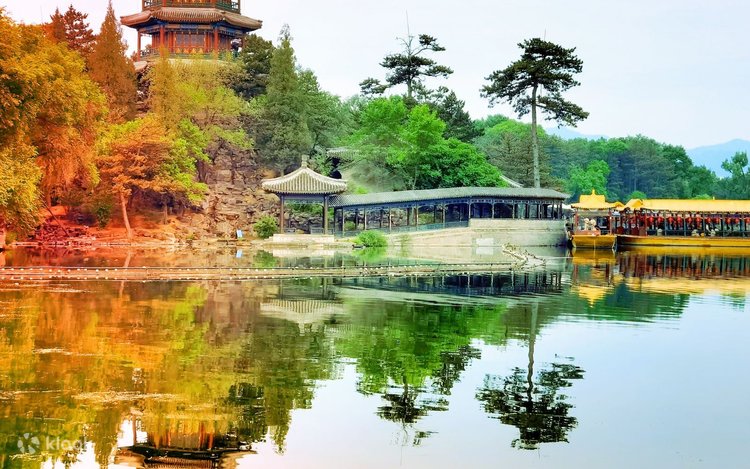
Construction of the Mountain Resort began in 1703, spanning the Kangxi, Yongzheng, and Qianlong reigns of the Qing Dynasty, taking 89 years to complete. It served as a meeting place for the Qing government with foreign envoys and ethnic minorities from the border regions, and was the second political center of the Qing Dynasty after Beijing. It embodies the “soft” side of the Qing government’s foreign policy, allowing foreign envoys to communicate with the Qing government without having to travel long distances to Beijing, transforming complex political objectives into a harmonious atmosphere within a quiet garden. The resort is divided into four main areas: the palace area and lake area in the south, and the mountain area and plain area in the north, with the palace area and lake area being the essence of the Mountain Resort. Palace Area: Upon entering the main entrance of the Mountain Resort (located on Lizhengmen Street), you will see the palace area, so it is generally the first area to visit. Because the Mountain Resort was the place where the Qing government met with foreign countries, the resort was built according to the etiquette of receiving foreign guests, so the specifications are extremely high, equivalent to the specifications of the Forbidden City. At the same time, in order to show the Chinese nation’s traditional virtues of humility and thrift in front of foreign guests, the overall layout of the palace area appears simple and generous, but the building materials used are very precious. The main hall, Danbo Jingcheng Hall, is entirely made of Phoebe zhennan wood, a standard of “low-key luxury,” and the design can be described as “meticulous.” Entering through the gate with the plaque “Mountain Resort Museum,” the tour of the palace area begins. You will see the Yueshe Gate with the plaque “Mountain Resort” inscribed by Emperor Kangxi, the main hall Danbo Jingcheng Hall, Yanbo Zhishuang Hall where Emperors Jiaqing and Xianfeng died, and so on. It takes about 2 hours to tour the palace area. Exiting from the back door and going down a slope, you will arrive at the boarding point for the mountain area tour bus. Mountain Area: If time permits, after visiting the palace area, take the mountain tour bus to visit the mountain area. If time is limited, you can skip the mountain area and go directly to the lake area. The mountain area accounts for four-fifths of the area of the Mountain Resort. Wealthy families build gardens with a few small rockeries for embellishment, but it is unheard of to enclose the vast mountains. Emperor Kangxi’s deep meaning in building the Mountain Resort was probably to remind future generations not to forget that their nation came from beyond the distant mountains, and not to forget the foreign tribes outside the mountains who were eyeing their territory. The mountain tour bus will pass many attractions along the way, but you can only see them from the bus. The only three stops where tourists can get off to visit are “Simian Yunshan,” “Erma Road,” and “Qingfeng Lvyu.” The more interesting of the three stops is “Erma Road.” Standing on the wall of the Mountain Resort, you can see the Putuo Zongcheng Temple (commonly known as “Little Potala Palace”) and Puning Temple among the Outer Eight Temples (religious sites built for ethnic minorities who met with the Qing Dynasty). The golden roof of the Little Potala Palace shines brightly in the sun and is particularly eye-catching. The mountain tour bus arrives at “Fangyuanju,” which is the final stop. Fangyuanju is located on the west bank of Ruyi Lake, and you can directly visit the lake area after getting off the bus. Lake Area: The reason why there are pavilions and towers on the lake surface in the north like the Mountain Resort is due to the love of Emperors Kangxi and Qianlong for the scenery of Jiangnan. Although the lake area imitates the characteristics of Jiangnan architecture combined with water, it is much more grand than the small bridges and flowing water of Jiangnan. The Mountain Resort has a total of “Kangxi and Qianlong’s 72 Scenes” - 36 scenes inscribed by Kangxi and 36 scenes inscribed by Qianlong. It is actually impossible to collect all 72 scenes, some scenes are very small, and you may miss them if you walk around without paying attention. However, 31 of the 72 scenes are in the lake area, and visiting the lake area is equivalent to visiting the “condensed version” of the 72 scenes. Among them, the Misty Rain Tower is a must-see, modeled after the Misty Rain Tower in Nanhu Lake in Jiaxing, and is one of the filming locations for the TV series “Huanzhugege.” In the lake area, you can also take a paddle boat and go boating on the lake, reference price 50 yuan/hour. Plain Area: Located between the mountain area and the lake area, it can be reached by walking north along the east side of the Mountain Resort from the lake area. The western part of the plain area is a grassland, mainly the Shimatai where the emperor held horse racing activities; the eastern part is woodland, called Wanshu Garden, with 28 yurts of different specifications in the garden. The plain area also has the Royal Library Wenjin Pavilion, which once housed the “Siku Quanshu,” as well as Yongyou Temple, Chunhao Xuan, and Suyun Yan. If you are particularly interested in Qing Dynasty history and have done some research, the many steles in the Mountain Resort are worth savoring. The builders of the Mountain Resort would not have imagined that it would become a tourist destination a century later. There are certainly steles with verbose and literal content, but more of them are intimate words for their own family. For example, Emperor Qianlong wrote six poems on the same stone tablet in Neisong Yunxia, expressing his desire to be a carefree cloud and wild crane after his success and fame. His son, Jiaqing, could only silently express on the steles next to him: My father’s poems are really profound, and I feel a lot of pressure! (瞻题蕴精奥,守位重仔肩!) Around the Mountain Resort are the Putuo Zongcheng Temple (commonly known as “Little Potala Palace”), Puning Temple, and the Hammer Peak Scenic Area, which can be visited together. There are no places to eat in the Mountain Resort, so it is recommended that tourists who visit for a long time and like to take their time bring some dry food. However, there are many characteristic restaurants outside the Mountain Resort. After leaving the Mountain Resort, you can try Chengde’s special dishes, such as mutton soup, Laogao, fresh flower rose cake, Nansha cake, and Royal Lotus Leaf Chicken.
You might also like...
Promo codes

5% off min. INR24,178.70
All you need to know
Attraction info

Opening hours
See more

Location
Mountain Resort

Guidebook
The Mountain Resort in Chengde, a Qing Dynasty royal garden, blends northern and southern landscaping art. Surrounded by the Outer Eight Temples, it features mountains and water reflecting each other, a gathering of historical sites, and a cool summer climate, combining historical and natural beauty.
Construction of the Mountain Resort began in 1703, spanning the Kangxi, Yongzheng, and Qianlong reigns of the Qing Dynasty, taking 89 years to complete. It served as a meeting place for the Qing government with foreign envoys and ethnic minorities from the border regions, and was the second political center of the Qing Dynasty after Beijing. It embodies the “soft” side of the Qing government’s foreign policy, allowing foreign envoys to communicate with the Qing government without having to travel long distances to Beijing, transforming complex political objectives into a harmonious atmosphere within a quiet garden. The resort is divided into four main areas: the palace area and lake area in the south, and the mountain area and plain area in the north, with the palace area and lake area being the essence of the Mountain Resort. Palace Area: Upon entering the main entrance of the Mountain Resort (located on Lizhengmen Street), you will see the palace area, so it is generally the first area to visit. Because the Mountain Resort was the place where the Qing government met with foreign countries, the resort was built according to the etiquette of receiving foreign guests, so the specifications are extremely high, equivalent to the specifications of the Forbidden City. At the same time, in order to show the Chinese nation’s traditional virtues of humility and thrift in front of foreign guests, the overall layout of the palace area appears simple and generous, but the building materials used are very precious. The main hall, Danbo Jingcheng Hall, is entirely made of Phoebe zhennan wood, a standard of “low-key luxury,” and the design can be described as “meticulous.” Entering through the gate with the plaque “Mountain Resort Museum,” the tour of the palace area begins. You will see the Yueshe Gate with the plaque “Mountain Resort” inscribed by Emperor Kangxi, the main hall Danbo Jingcheng Hall, Yanbo Zhishuang Hall where Emperors Jiaqing and Xianfeng died, and so on. It takes about 2 hours to tour the palace area. Exiting from the back door and going down a slope, you will arrive at the boarding point for the mountain area tour bus. Mountain Area: If time permits, after visiting the palace area, take the mountain tour bus to visit the mountain area. If time is limited, you can skip the mountain area and go directly to the lake area. The mountain area accounts for four-fifths of the area of the Mountain Resort. Wealthy families build gardens with a few small rockeries for embellishment, but it is unheard of to enclose the vast mountains. Emperor Kangxi’s deep meaning in building the Mountain Resort was probably to remind future generations not to forget that their nation came from beyond the distant mountains, and not to forget the foreign tribes outside the mountains who were eyeing their territory. The mountain tour bus will pass many attractions along the way, but you can only see them from the bus. The only three stops where tourists can get off to visit are “Simian Yunshan,” “Erma Road,” and “Qingfeng Lvyu.” The more interesting of the three stops is “Erma Road.” Standing on the wall of the Mountain Resort, you can see the Putuo Zongcheng Temple (commonly known as “Little Potala Palace”) and Puning Temple among the Outer Eight Temples (religious sites built for ethnic minorities who met with the Qing Dynasty). The golden roof of the Little Potala Palace shines brightly in the sun and is particularly eye-catching. The mountain tour bus arrives at “Fangyuanju,” which is the final stop. Fangyuanju is located on the west bank of Ruyi Lake, and you can directly visit the lake area after getting off the bus. Lake Area: The reason why there are pavilions and towers on the lake surface in the north like the Mountain Resort is due to the love of Emperors Kangxi and Qianlong for the scenery of Jiangnan. Although the lake area imitates the characteristics of Jiangnan architecture combined with water, it is much more grand than the small bridges and flowing water of Jiangnan. The Mountain Resort has a total of “Kangxi and Qianlong’s 72 Scenes” - 36 scenes inscribed by Kangxi and 36 scenes inscribed by Qianlong. It is actually impossible to collect all 72 scenes, some scenes are very small, and you may miss them if you walk around without paying attention. However, 31 of the 72 scenes are in the lake area, and visiting the lake area is equivalent to visiting the “condensed version” of the 72 scenes. Among them, the Misty Rain Tower is a must-see, modeled after the Misty Rain Tower in Nanhu Lake in Jiaxing, and is one of the filming locations for the TV series “Huanzhugege.” In the lake area, you can also take a paddle boat and go boating on the lake, reference price 50 yuan/hour. Plain Area: Located between the mountain area and the lake area, it can be reached by walking north along the east side of the Mountain Resort from the lake area. The western part of the plain area is a grassland, mainly the Shimatai where the emperor held horse racing activities; the eastern part is woodland, called Wanshu Garden, with 28 yurts of different specifications in the garden. The plain area also has the Royal Library Wenjin Pavilion, which once housed the “Siku Quanshu,” as well as Yongyou Temple, Chunhao Xuan, and Suyun Yan. If you are particularly interested in Qing Dynasty history and have done some research, the many steles in the Mountain Resort are worth savoring. The builders of the Mountain Resort would not have imagined that it would become a tourist destination a century later. There are certainly steles with verbose and literal content, but more of them are intimate words for their own family. For example, Emperor Qianlong wrote six poems on the same stone tablet in Neisong Yunxia, expressing his desire to be a carefree cloud and wild crane after his success and fame. His son, Jiaqing, could only silently express on the steles next to him: My father’s poems are really profound, and I feel a lot of pressure! (瞻题蕴精奥,守位重仔肩!) Around the Mountain Resort are the Putuo Zongcheng Temple (commonly known as “Little Potala Palace”), Puning Temple, and the Hammer Peak Scenic Area, which can be visited together. There are no places to eat in the Mountain Resort, so it is recommended that tourists who visit for a long time and like to take their time bring some dry food. However, there are many characteristic restaurants outside the Mountain Resort. After leaving the Mountain Resort, you can try Chengde’s special dishes, such as mutton soup, Laogao, fresh flower rose cake, Nansha cake, and Royal Lotus Leaf Chicken.