Kiyomizudera Temple Reviews
Popular places near Kiyomizudera Temple
FAQs about Kiyomizudera Temple
What is special about the Kiyomizu Temple?
What is special about the Kiyomizu Temple?
Is it better to go to Kiyomizu-dera in the morning or at night?
Is it better to go to Kiyomizu-dera in the morning or at night?
Was Kiyomizu-dera built without nails?
Was Kiyomizu-dera built without nails?
Is Kiyomizu worth it?
Is Kiyomizu worth it?
Are there regulations for visiting Kiyomizudera Temple?
Are there regulations for visiting Kiyomizudera Temple?
What to know about Kiyomizudera Temple
The Temple of Pure Water: Kiyomizu-dera Temple
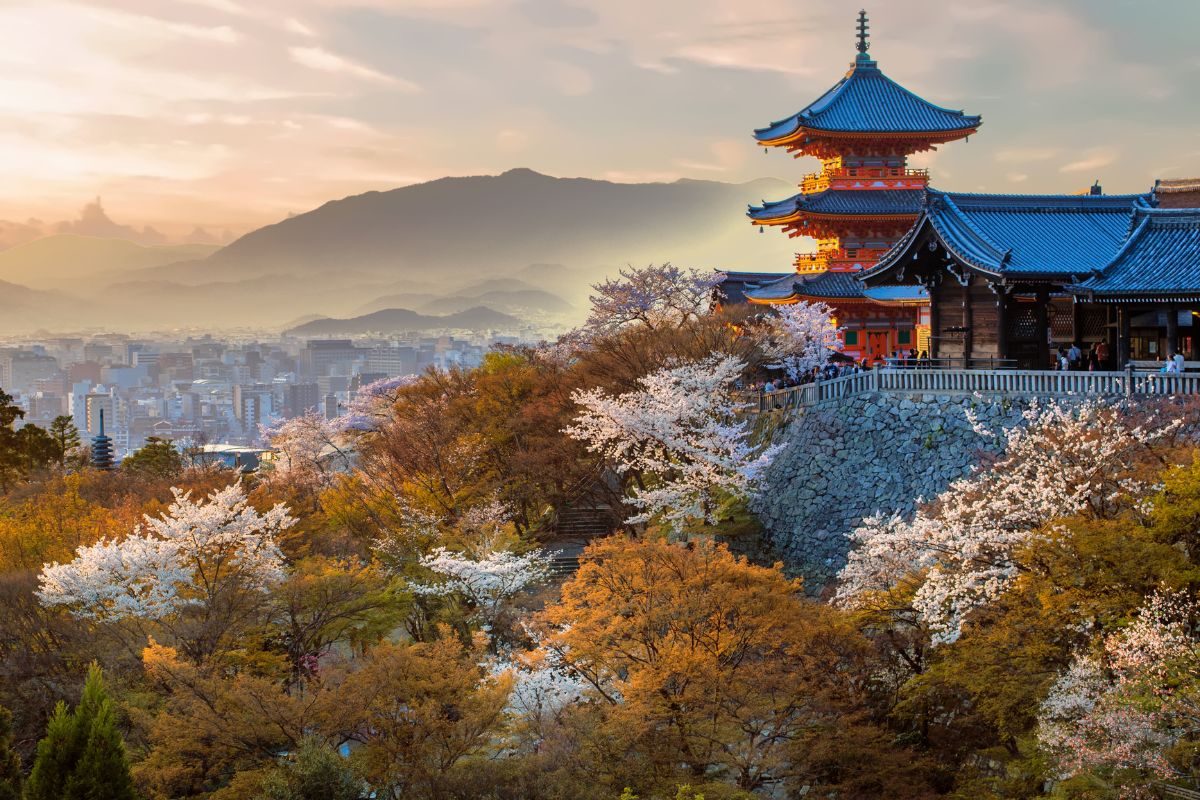
Kiyomizu-dera History
A journey to Kiyomizu-dera is a walk through over 1,200 years of rich Japanese history, filled with legends, devotion, and remarkable resilience. Its story begins in 778, long before Kyoto was the imperial capital. According to legend, a monk named Enchin had a vision that led him to a pristine waterfall in the forests of Otowa Mountain. There, he met a hermit who entrusted him with a sacred piece of wood to carve an image of the Kannon Bodhisattva, the goddess of mercy and compassion. Enchin enshrined this statue, and the temple, named Kiyomizu-dera or "Pure Water Temple," was founded in honour of the sacred Otowa Waterfall that inspired its creation.
The temple grew in prominence when the famed shogun Sakanoue no Tamuramaro donated the land and sponsored the construction of a grand main hall in 798 to give thanks to the Kannon for his military victories. Throughout its long history, Kiyomizu-dera has been destroyed by fires and conflicts numerous times, yet it has been faithfully rebuilt on each occasion. The magnificent structures we see today, including the iconic wooden stage built without a single nail, date back to its last major reconstruction in 1633 under the order of the shogun Tokugawa Iemitsu during the Edo Period. In 1994, Kiyomizu-dera's profound historical and cultural importance was officially recognized when it was designated as a UNESCO World Heritage site, cementing its status as an enduring symbol of faith and a masterpiece of Japanese architecture that has captivated pilgrims and visitors for centuries.
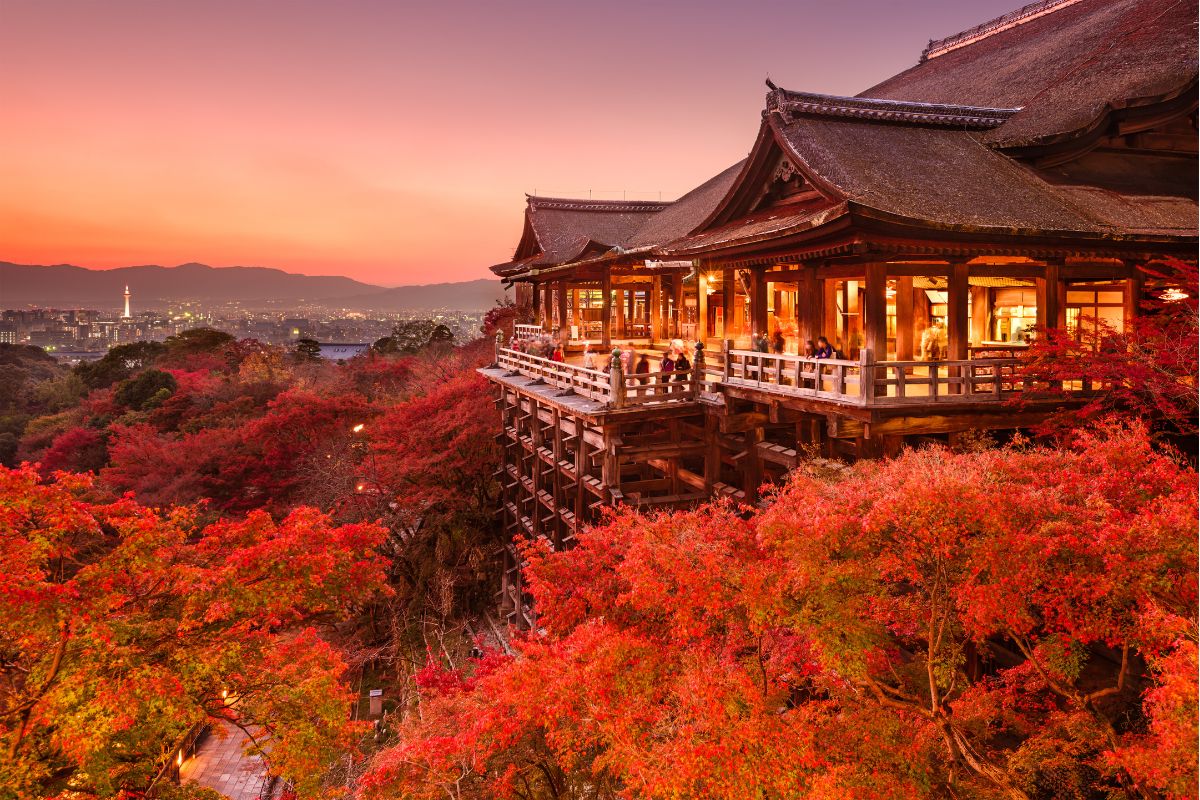
Kiyomizu-dera's Iconic Architecture
Kiyomizu-dera's most iconic feature is its massive wooden stage, a masterpiece of traditional Japanese carpentry. The entire structure, including its 12-meter-high pillars and expansive cypress floor, was ingeniously constructed using intricate, interlocking wooden joints without the use of a single nail. Connected to the main hall where the thousand-armed Kannon deity is enshrined, this stage offers spectacular, year-round views of the city below. So revered and dramatic is this veranda that it gave rise to the popular Japanese phrase "to jump off the stage at Kiyomizu," a saying used to describe a bold, decisive action, much like "taking the plunge."
Must-Visit Attractions at Kiyomizu Temple
Butai (Kiyomizu's Wooden Stage)
Discover the extraordinary wooden stage complex of Kiyomizu-dera, showcasing 168 pillars and providing breathtaking vistas of Kyoto. Crafted without the use of nails, this architectural wonder symbolizes pure traditional Japanese craftsmanship.
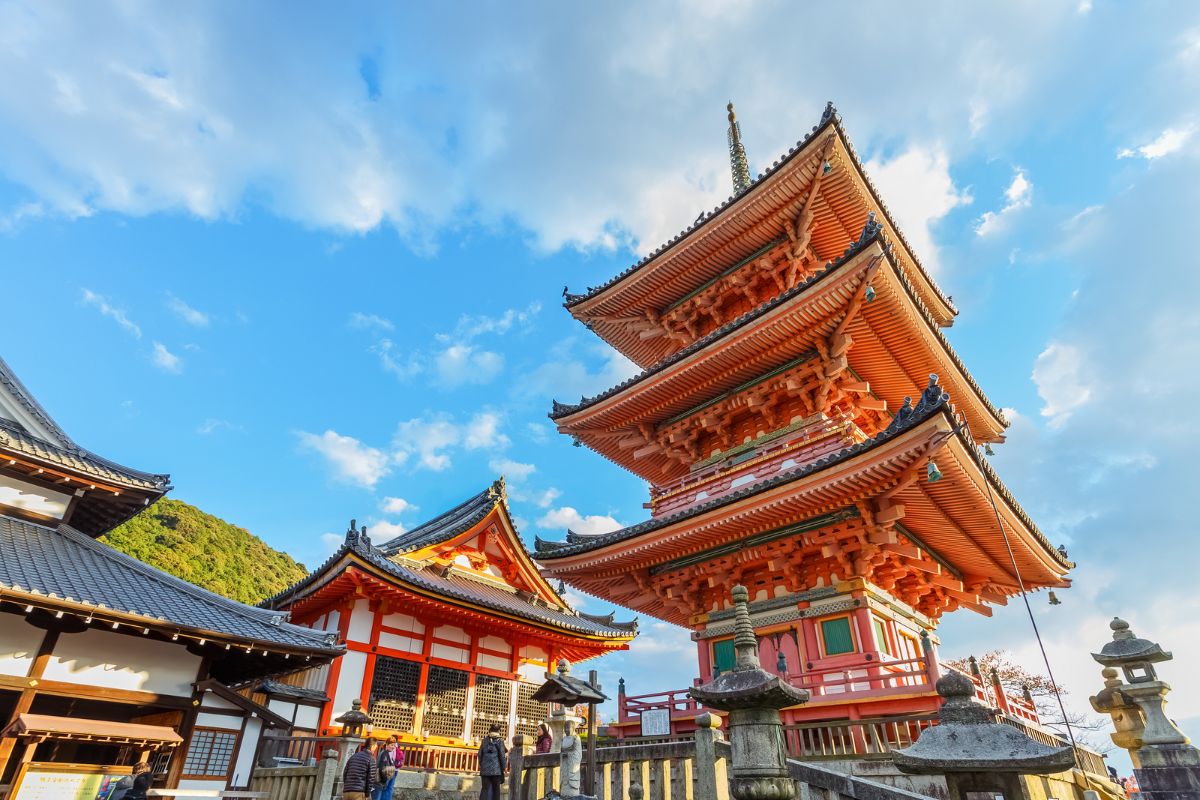
Three Story Pagoda
Soaring 31 meters into the sky, Kiyomizu-dera's magnificent Three-Story Pagoda is one of the tallest in all of Japan. Reconstructed in 1633, its brilliant vermilion hue stands out dramatically against the forested hillside. As you gaze up at its intricate roof, you'll spot the traditional fierce onigawara demon tiles meant to ward off evil. Look closer at the southeastern corner for a hidden treasure: a unique dragon tile, enshrined as a water god, perpetually standing guard to protect this sacred wooden structure from fire.
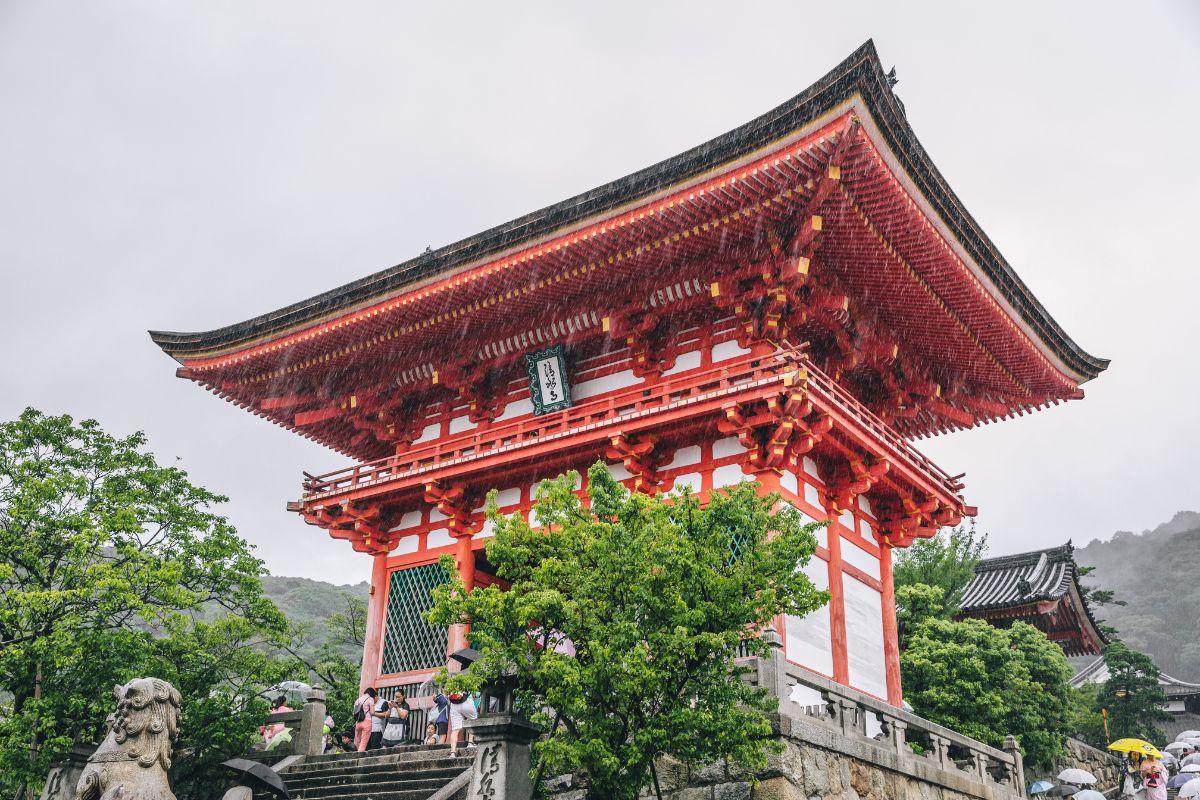
Niomon Gate
The Niomon Gate serves as the majestic main entrance to the Kiyomizu-dera Temple complex, immediately capturing attention with its grand scale and vibrant vermilion lacquer. This impressive two-story gate is a designated Important Cultural Property and is flanked by two fierce Nio guardian statues, Agyo and Ungyo, who protect the sacred grounds within. Passing through this imposing structure, with its intricate wooden joinery and powerful presence, marks the official start of a visitor's journey into one of Kyoto's most revered sites.
Bell Tower
Visit the colorful bell tower surrounded by chrysanthemum flowers and rich history. Make sure to visit on New Year's Eve, where you can see the bell-ringing ceremony, a symbolic ritual that marks the passage of time.
Jishu Shrine
Jisu Shrine is devoted to the deity of love and matchmaking. Located in front of the shrine are two stones set 18 meters apart. Legend has it that going from one stone to the other with closed eyes brings luck in love. Alternatively, having someone assist you on this journey signifies the need for a mediator in your romantic endeavors.
Otowa Waterfall
Located at the base of Kiyomizudera's main hall, discover the Otowa Waterfall. The waterfall cascades into three streams, where you can use the long-poled cups to sip from each. Each stream is believed to offer distinct blessings-longevity, academic triumph, and luck in love. Though getting from all three streams is viewed as excessive.
Okunoin Hall
While the most famous "Okunoin" in Japan is the sacred cemetery at Mount Koya, Kiyomizu-dera Temple has its own important inner sanctum called the Okuno-in Hall. Located on the hillside just above the sacred Otowa Waterfall, this hall is architecturally similar to the main temple building and features its own smaller wooden stage. Its primary fame, however, comes from the breathtaking view it offers. From the veranda of the Okuno-in, visitors can capture the iconic, postcard-perfect photograph of the main stage jutting out from the forest, with the city of Kyoto stretching out in the background. Also dedicated to the Kannon Bodhisattva, this hall provides a slightly more tranquil spot to fully appreciate the temple's grand scale and beautiful mountain setting.
Kiyomizu-dera's Festivals & Night Illuminations
Kiyomizu-dera Temple is not just a static historical site; it's a living place of worship with a vibrant calendar of special events. These occasions offer visitors a chance to see the temple in a completely different light, often extending its hours into the evening for truly magical experiences.
Here are the most significant special events happening at Kiyomizu-dera:
Special Night Illuminations
This is the temple's most famous and popular event, held three times a year. During these periods, the temple reopens after dusk, and hundreds of lights illuminate the temple buildings and surrounding nature. The effect is breathtaking, transforming the familiar daytime view into a mystical and dramatic landscape. A single, powerful blue beam of light is projected from the temple into the night sky, symbolizing the compassion of the Kannon Bodhisattva.
The night illuminations are timed to coincide with the peak beauty of the seasons:
Spring Illumination (late March - early April): Held to celebrate the cherry blossom season. The illuminated sakura trees create a stunning, dreamlike canopy around the glowing temple halls and pagoda.
Summer Illumination (mid-August): This coincides with the Sennichi-mairi or "Thousand-day Pilgrimage" period, a time when a prayer is said to be worth a thousand days of worship. It also aligns with Obon, a time to honour ancestral spirits.
Autumn Illumination (mid-November - early December): This is perhaps the most spectacular of all. The fiery red and gold of the autumn maple leaves are lit up, creating an intense and beautiful contrast with the illuminated wooden stage and the Kyoto city lights in the distance.
Seiryu-e: The Blue Dragon God Festival
This dynamic and colourful procession is a relatively modern festival, but it's based on ancient legends. It is held three times a year, in March, April, and October. The festival honours Seiryu, a blue dragon and one of the four divine beasts said to protect Kyoto from the east, with Kiyomizu-dera considered its home base.
The highlight is an 18-meter-long dragon figure, beautifully crafted and covered in sutras, which is carried through the temple grounds and the surrounding neighbourhood. Accompanied by performers in elaborate costumes and the sound of conch shells, the procession is a prayer for regional peace and a spectacle of vibrant energy that brings the temple's mythology to life.
Sennichi-mairi: Thousand-day Pilgrimage
Held in mid-August, this is a deeply significant religious event. It is believed that visiting the temple during this period grants the same blessings as praying for one thousand consecutive days. During this time, the main hall's innermost sanctuary, which is normally closed, is opened to the public, allowing visitors a rare chance to be closer to the temple's principal image of the Kannon Bodhisattva. The summer night illuminations are held in conjunction with the final days of this event.
These events draw significant crowds, so it is always wise to plan your visit in advance. Attending one of these special occasions offers a deeper, more enchanting perspective on one of Kyoto's most beloved and sacred sites.
Tips for Your Kiyomizu Temple Visit
When is the best time to visit Kiyomizu Temple?
The ideal times to visit Kiyomizu-dera Temple are during the spring and autumn seasons. In late March to early April, the cherry blossoms are in full bloom, creating a picturesque setting. Similarly, from mid-November to early December, the autumn leaves transform the area into a vibrant tapestry of colors.
How to get to Kiyomizu Temple in Kyoto?
Kiyomizudera Temple is located in the Higashiyama district of Kyoto, easily accessible by bus, train, or on foot:
By Bus: From Kyoto Station, take bus No. 100 or 206 to the Gojo-zaka or Kiyomizu-michi bus stop (about 15 minutes). From there, it's a 10-minute uphill walk through charming shopping streets.
By Train: Take the Keihan Main Line to Kiyomizu-Gojo Station, then walk about 20 minutes uphill to the temple. Alternatively, from Kawaramachi Station (Hankyu Line), it's around a 25-minute walk.
By Taxi: A taxi from Kyoto Station takes about 10 minutes, dropping you closer to the entrance, which is convenient if traveling with children or elderly companions.
On Foot: Many visitors enjoy walking from nearby attractions like Gion or Yasaka Shrine, taking in the historic Higashiyama streets along the way.
What are the operating hours of Kiyomizu Temple?
Kiyomizu-dera Temple is open from 6:00 AM to 6:00 PM, with extended hours until 6:30 PM in July and August. During special evening illuminations, the temple remains open until 9:30 PM, with the last entry at 9:00 PM.
How long should I spend at Kiyomizu Temple?
If you're on the go, a quick tour of Kiyomizu Temple will take around 30 minutes. However, for a more in-depth exploration of the temple grounds, set aside about two hours to fully explore all the sites at the temple complex.
Temples Near Kiyomizu-dera: The Ultimate Walker's Guide
Kiyomizu-dera is the anchor of Kyoto's stunningly preserved Southern Higashiyama district, which is filled with beautiful temples, shrines, and historic streets. You can easily spend a full day exploring the area on foot.
Here are the most notable temples and shrines near Kiyomizu-dera, listed in a logical walking order from the top of the hill downwards.
Jishu Shrine
Location: Directly within the Kiyomizu-dera Temple complex, just behind the main hall.
Why Visit: It is famously dedicated to the god of love and matchmaking. The shrine is best known for its pair of "love stones" placed several meters apart. Successfully walking from one stone to the other with your eyes closed is said to mean you will find true love.
Important Note: As of August 2025, Jishu Shrine is closed to the public for long-term restoration work expected to last several years. You will be able to see the exterior but cannot enter the grounds or interact with the love stones.
Kodai-ji Temple
Location: A 10-15 minute walk downhill from Kiyomizu-dera, just off the historic Ninenzaka slope.
Why Visit: This is an elegant and often less crowded temple with exceptional beauty. It was established in 1606 by the noblewoman Nene in memory of her late husband, the powerful warlord Toyotomi Hideyoshi.
Highlights: Kodai-ji features magnificent Zen gardens (one of which was designed by the famous master Kobori Enshu), beautifully decorated memorial halls, and a small but enchanting bamboo grove that offers a peaceful alternative to the one in Arashiyama.
Yasaka Koshindo
Location: A small but vibrant temple located near the iconic Yasaka Pagoda (Hokan-ji Temple), about a 5-minute walk from Kodai-ji.
Why Visit: It's one of Kyoto's most colourful and photogenic spots. The temple is adorned with thousands of brightly coloured cloth balls called kukurizaru. Worshippers write a wish on these balls, and it is believed that by giving up a desire (symbolized by the ball), their wish is more likely to come true.
Yasaka Shrine
Location: At the very end of the walking path from Kiyomizu-dera, at the eastern end of Shijo Avenue, bordering the famous Gion district. It's about a 20-25 minute total walk from Kiyomizu-dera.
Why Visit: This is one of Kyoto's most important and popular shrines, acting as the spiritual heart of the Gion district. It is the host of the city's largest festival, the Gion Matsuri, every July.
Highlights: Yasaka shrine has a lively, festive atmosphere day and night. Its impressive main gate is a famous landmark, and its central offering hall is beautifully decorated with hundreds of lanterns that are lit in the evening, creating a magical glow.
Other Attractions Near Kiyomizudera Temple
Sannenzaka & Ninenzaka Slopes
These are the quintessential attractions of the area. Sannenzaka and Ninenzaka Slopes are a pair of beautifully preserved, stone-paved pedestrian lanes that wind down the hill from Kiyomizu-dera. The streets are lined with traditional wooden machiya townhouses that now house a wonderful array of shops selling local crafts (like Kiyomizu-yaki pottery), sweet shops offering treats like mochi and matcha ice cream, and charming cafes. The atmosphere feels like a step back in time.
Ishibei-koji Lane
Tucked away near Kodai-ji Temple, this is a quieter and incredibly atmospheric narrow lane. Its stone-paved path is flanked by high walls of traditional inns (ryokan) and exclusive restaurants. It feels like a hidden secret and is especially beautiful in the evening when the lanterns are lit.
Gion District
Yasaka Shrine marks the entrance to Gion, Kyoto's most famous geisha district. It's an essential area to explore, especially as evening approaches.
Hanamikoji Street: The main street of Gion, lined with well-preserved wooden buildings, many of which are exclusive ochaya (teahouses) where geishas entertain guests.
Shirakawa Lane: A stunningly beautiful and often quieter area that runs alongside a small canal lined with willow trees.
Maruyama Park
Maruyama Park is located directly behind Yasaka Shrine, this is Kyoto's oldest public park and a beautiful place to relax. It's famous for its giant weeping cherry tree and provides a tranquil green space to rest your feet after a long walk.
Explore more on Klook
Top attractions in Kyoto
- 1 Arashiyama
- 2 Fushimi Inari Taisha
- 3 Sanzen-in Temple
- 4 Kinkakuji Temple
- 5 Gion
- 6 Nishiki Market
- 7 Nijō Castle
- 8 Arashiyama Bamboo Forest
- 9 Fushimi Jikkokubune
- 10 Kyoto Station
- 11 Kyoto Imperial Palace
- 12 Pontocho
- 13 Kamo River
- 14 Toei Kyoto Studio Park
- 15 Arashiyama Monkey Park Iwatayama
- 16 Ninenzaka
- 17 Kitano Tenmangu Shrine
- 18 Kurama Hot Spring
- 19 Sanjusangen-do Temple