


Do you need a visa? Here's the short answer
If you're holding an Australian passport, you don't need a visa to visit mainland China. Since 1 July 2024, China has run a visa-free scheme for Australians, and it was extended again in November 2025 to run through to 31 December 2026. That means ordinary Australian passport holders can currently enter mainland China visa-free for up to 30 days at a time, for a holiday, business trip, family visit, cultural exchange or transit.
That covers the mainland China entry requirements for Australia that most people are searching for. But no visa doesn't mean no paperwork — there's an arrival card to file, a passport rule to check, and a police registration step that trips up a lot of first-timers. This guide runs through everything, then points you toward your first stops once you land.
Mainland China entry requirements for Australia at a glance
Requirement | What to know |
|---|---|
Visa | Not required for stays up to 30 days (holiday, business, family visits, exchange, transit) |
China visa-free extension 2026 | Runs to 31 December 2026; first introduced 1 July 2024, extended twice since |
Maximum stay | 30 days per entry, multiple entries allowed |
Passport validity | At least 6 months remaining from your entry date |
China arrival card | Mandatory online form, filed free before you fly |
PSB registration | Register your address with local police within 24 hours (hotels sort this automatically) |
Longer stays / other passports | Diplomatic and official passport holders, and stays over 30 days, still need a China visa Australia application |
Hong Kong & Macau | Separate entry arrangements, not covered by this policy |
Section A: What you actually need to enter mainland China
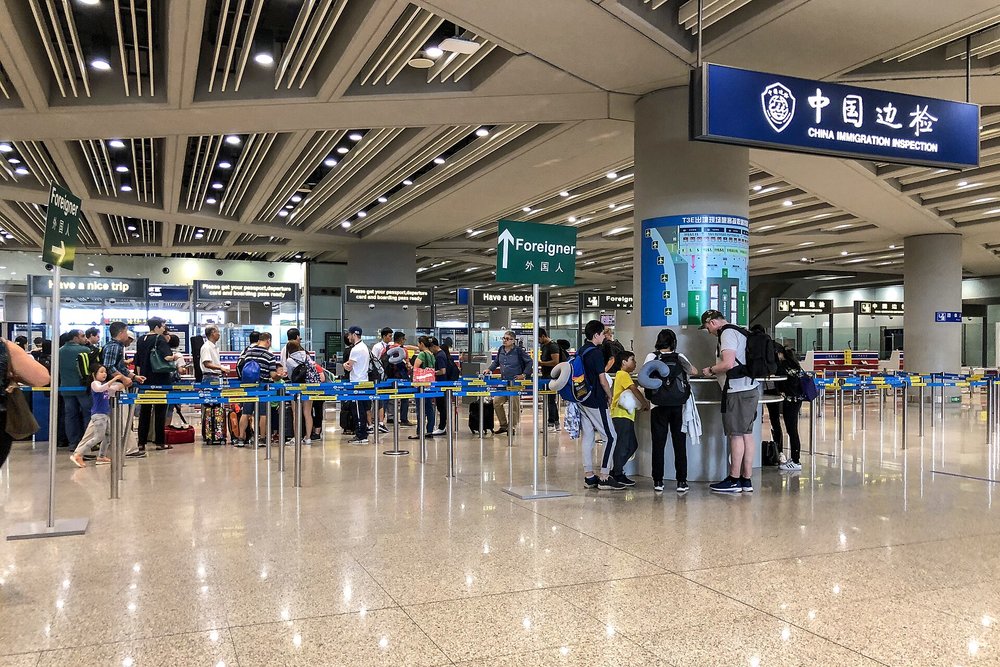
China Immigration Inspection | Image Credits: N509FZ, CC BY-SA 4.0 via Wikimedia Commons
The China 30-day visa exemption, explained
Australian passport holders get the China 30-day visa exemption for stays of up to 30 days per entry, for tourism, business, family visits, cultural or educational exchange, or transit. It's worth knowing the history here, since it explains why the policy keeps coming up in conversation: it started as a 15-day trial on 1 July 2024, doubled to 30 days from 30 November 2024, and rather than lapsing, it was rolled forward again in November 2025 for the China visa-free extension 2026, this time through to 31 December 2026.
You can make multiple visa-free entries, with no current cap on total days across the year — just a 30-day limit on any single stay. If your route has you leaving mainland China partway through (a stopover in Hong Kong or Seoul, say) and coming back, that's allowed under the rules as they currently stand. One thing to flag: the visa-free entry doesn't cover paid employment, so if you're heading over for work rather than meetings, you'll need to sort a China visa Australia application through the embassy first.
Passport validity and the China arrival card
Your Australian passport China entry needs at least six months of validity left from the date you arrive, so check this before you book flights rather than after. Since 20 November 2025, everyone entering mainland China — including visa-free travellers — also needs to file a China arrival card Australia travellers can complete online, free, through the National Immigration Administration before they fly. It asks for your passport details, flight information and first night's accommodation address, then generates a QR code you may need to show at immigration.
Klook Tip: File the arrival card yourself through the official government channel. Third-party sites that charge a fee for the same form aren't necessary — and if you can't file in advance, there are QR scanners and paper forms at the port of entry as a backup.
PSB registration: the step people forget
China's PSB registration rule (Public Security Bureau) means every foreign visitor has to register their accommodation address with local police within 24 hours of arriving, and being visa-free doesn't get you out of it. Staying in a hotel takes care of this automatically, since they scan your passport at check-in. Staying with family, friends or in a private rental puts the registration on you or your host instead, usually at the local police station.
These three steps — arrival card, passport check, PSB registration — are the parts of the mainland China entry rules that actually catch people out, since the visa-free headline makes it easy to assume there's nothing left to do.
What's still excluded
A couple of groups fall outside the mainland China entry requirements for Australia covered here. Diplomatic and official passport holders aren't included in the visa-free scheme and still need a visa. Stays longer than 30 days, whether for study, work or an extended visit, also need a visa arranged in advance, since there's no extension option at the border. Hong Kong and Macau run their own separate entry arrangements too, so this policy doesn't carry over if your trip includes either.
Section B: Must-visit spots once you land

Tiananmen Square, Beijing, China | Image Credits: Dominic Kurniawan Suryaputra via Unsplash
Forbidden City
Most first-time visitors start in Beijing, and the Forbidden City is the obvious opener. It's the former imperial palace, and the scale of it (nearly 1,000 buildings) makes it worth a half-day at minimum. Go early to beat the tour groups and the midday heat in summer.
Pair it with Tiananmen Square next door, one of the largest public squares in the world and the classic entry point to a Beijing itinerary. The two sit close enough to walk between, so they're easy to fit into the same morning.
Where to stay in Beijing
Basing yourself in Beijing for a few nights gives you time to work through the city properly before heading further afield. It's also the easiest jumping-off point for a Great Wall day trip, so it's worth building extra time into your stay for that alone.
Mutianyu Great Wall
For most Beijing-based travellers, Mutianyu Great Wall is the easiest section to reach on a day trip, with cable cars and toboggan rides that make it more manageable than some of the steeper, further-out sections. A private transfer to Mutianyu takes the guesswork out of getting there, especially if it's your first time navigating transport outside the city.
Beijing to Shanghai by high-speed rail
Once you've covered Beijing, pairing it with Shanghai by high-speed rail is a popular next move; the two cities show quite different sides of mainland China in a single trip. Before you go, it's worth sorting a couple of things in advance: a China eSIM for high-speed internet so you've got data from the moment you land, and airport transfers booked ahead for both Beijing and Shanghai so you're not sorting out a ride after a long-haul flight.
FAQs about mainland China entry requirements Australia
Do Australians need a visa for China in 2026?
No, not for stays of up to 30 days for tourism, business, family visits, cultural exchange or transit. The China visa-free Australia policy is confirmed through 31 December 2026, so it's in effect for any trip booked within that window.
How many days can Australians stay in China visa-free?
Up to 30 days per entry under the China 30-day visa exemption. You can make multiple visa-free entries, with no current cap on total days across a year, just a 30-day limit on each individual stay.
What is the China arrival card and do I need to fill it out?
It's a mandatory entry form introduced in November 2025 covering your passport, travel and accommodation details. Almost every visitor entering mainland China needs to file one, including those on the 30-day visa-free scheme, and it's best done online and for free before you fly.
Does the China visa-free policy cover Hong Kong and Macau too?
No. Hong Kong and Macau have their own separate entry rules for Australian travellers, and this mainland China visa-free scheme doesn't extend to either.
Can I visit China visa-free more than once a year?
Yes. There's currently no limit on the number of visa-free entries or total days across multiple trips, just the 30-day cap on any single stay.
What happens if I want to stay in China longer than 30 days?
You'll need to apply for a visa before you travel. The visa-free entry has no extension option at the border, so longer stays for study, work or an extended visit need a standard China visa Australia application sorted ahead of time.
More China travel guides for you
![[usxanz] Universal Studios Beijing](https://res.klook.com/image/upload/fl_lossy.progressive,q_85/c_fill,w_550,h_356/v1729757088/xvvaefpw6drjvul6bgep.jpg)
What is Klook?
Klook is a leading pan-regional experiences platform in Asia Pacific, purpose built to digitalize experiences and make them accessible to every traveler.
Our mission is to build the digital infrastructure for the global experience economy — empowering merchants to share their passions and travelers to discover the heartbeat of each destination. We operate a mobile-first, curated platform featuring diverse experiences across global destinations.





![[Updated] Complete List Of Official Nationwide MCO SOP 2021](https://res.klook.com/image/upload/fl_lossy.progressive,q_85/c_fill,w_160,h_104/v1633858858/blog/iso56uzsphmdguixkvzh.jpg)





![[Updated] Complete List Of Official Nationwide MCO SOP 2021](https://res.klook.com/image/upload/fl_lossy.progressive,q_85/c_fill,w_410,h_264/v1633858858/blog/iso56uzsphmdguixkvzh.jpg)