
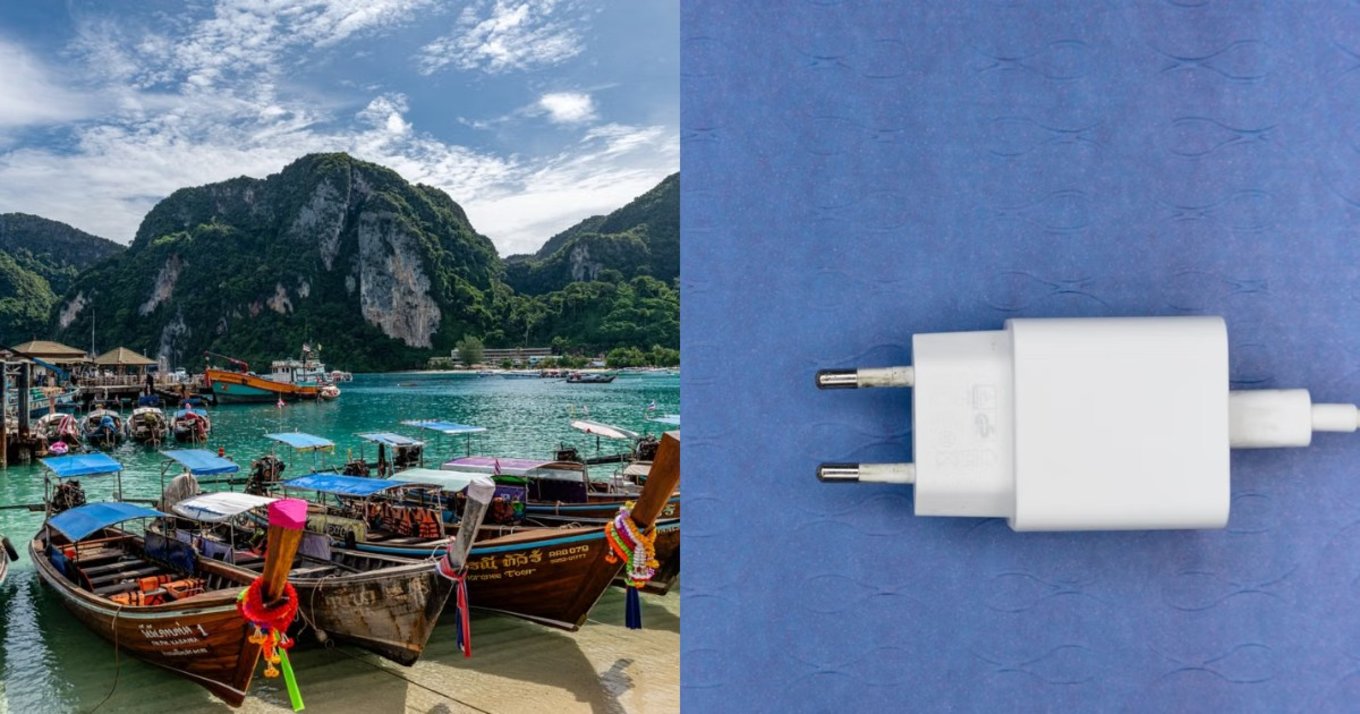
Landing in Bangkok with a 5% phone and a plug that won't fit the wall is a rough way to start a trip. Luckily, it only takes a couple of minutes to sort out before you fly. Thailand uses Type C and Type O as its official plug types, and most wall sockets also take Type A and Type B. The Thailand voltage is 230V at 50Hz, so the plug is rarely the problem; the voltage sometimes is.
If you're flying in from the UK or Australia, you need a plug adapter but no converter. From the EU, you can plug straight in with a standard two-pin charger. And if you're coming from the US or Canada, your plug usually fits, but a 120V-only device needs a voltage converter or it can burn out.
Heading to Thailand for more than a weekend? This guide covers the Thailand plug type question first, then adapters, hotels, power banks and staying online. A few small details make the difference.
Thailand plug types at a glance
Thailand Plug types
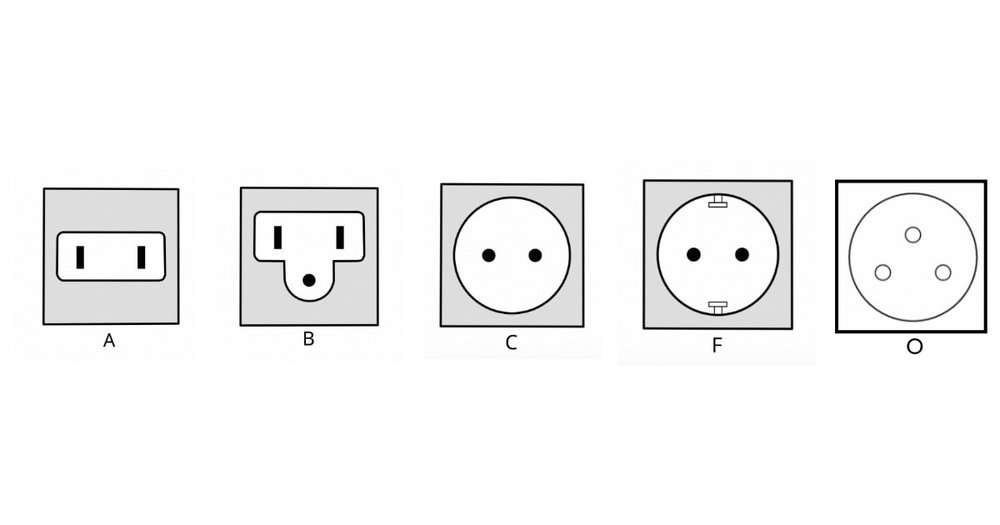
Match the plug on your charger to the table below and you'll know in seconds where you stand. Nearly every socket sold in Thailand today is a hybrid, which means one outlet accepts several plug shapes. For a Type A and Type C plug, Thailand's hybrid sockets are an easy match, so check those two first.
Plug type | What it looks like | Fits Thai sockets? | Good to know |
|---|---|---|---|
Type A | Two flat parallel pins | Yes, in most hybrid sockets | Used in the US, Canada and Japan |
Type B | Two flat pins plus a round ground pin | Often, in hybrid sockets | Some older outlets are a loose fit |
Type C | Two thin round pins | Yes, official standard | The common Europlug for phones and laptops |
Type F | Round pins with side ground clips | Fits, but the ground isn't connected | Fine for phone chargers; not ideal for grounded appliances |
Type O | Three round pins | Yes, official standard | Rare in the wild, so don't count on it |
Plugs from the UK (Type G) and Australia (Type I) don't fit, so you'll need an adapter if you're flying from either. One more thing to know: sockets in older buildings can feel loose even with the right plug. We'll come back to that below.
Thailand voltage and frequency
Look at the small print on your charger before anything else. Thailand's electricity runs at 230V and 50Hz, though some guides round it to 220V. Either number is far higher than the 120V used in the US and Canada, and Japan runs at 100V.
If your charger says "INPUT: 100-240V, 50/60Hz", you're set. That covers most phone chargers, laptops, tablets, cameras and power banks, and you only need a plug adapter. If the label shows a single voltage, such as 120V, that device isn't built for Thailand electricity.
Adapter vs voltage converter
An adapter changes the shape of the plug so it fits the socket. It does nothing to the voltage. A voltage converter changes the power itself, so a 120V device can run safely on 230V.
Most people only need the adapter, since modern electronics are dual-voltage. The usual exceptions are hair dryers, straighteners, electric shavers and some kettles. Leave those at home or buy a dual-voltage version, because a converter strong enough for a hair dryer is heavy and not cheap.
Do you need a Thailand plug adapter?
It depends on where you're flying from. Here's how it breaks down:
- US and Canada (Type A and B, 120V): Your plug usually fits the hybrid sockets. Dual-voltage devices work fine. Hair tools need a converter or a swap.
- UK (Type G, 230V): You need a Thailand plug adapter. No converter needed.
- EU (Type C and F, 230V): Type C goes straight in. Type F fits too, but the ground pin isn't connected, so skip it for anything that needs grounding.
- Australia and New Zealand (Type I, 230V): You need an adapter. No converter needed.
- Japan (Type A, 100V): The plug fits. Check labels, since 100V-only devices need a converter.
Whatever your Thailand plug type turns out to be, a universal Thailand travel adapter covers every row above in one go. If you're traveling on to another country afterwards, our plug guides for Japan, South Korea, China and Bali spell out what changes there.
What to expect in hotels, airports and hostels
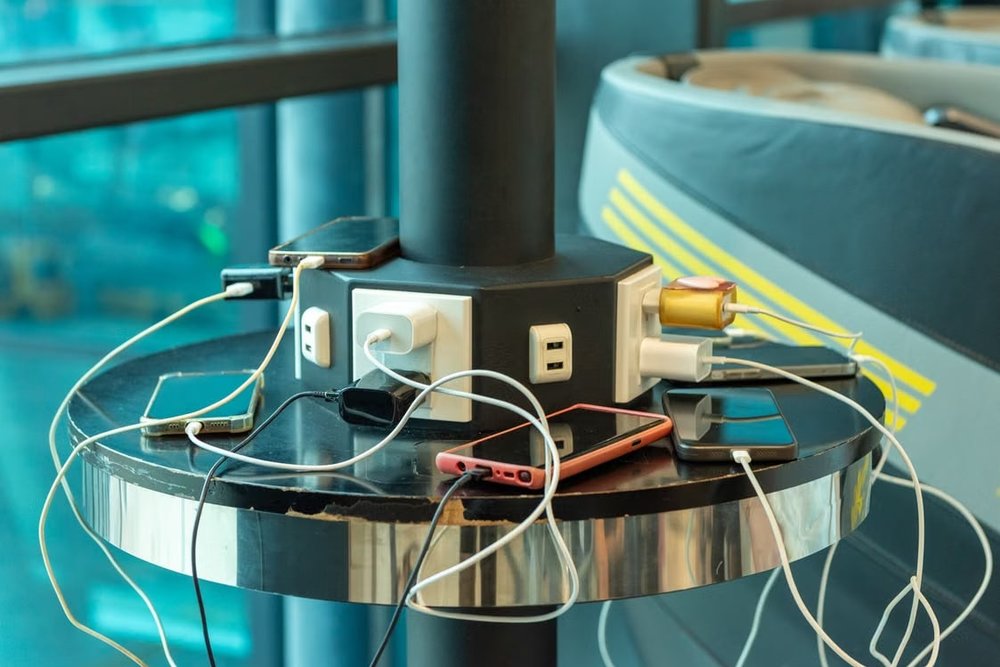
Airport sockets | Image credits: KIEU TRUONG via Pexels
Many mid-range and higher hotels in Bangkok have hybrid sockets, and some add USB ports by the bed. That means one cable can charge your phone without an adapter at all. Budget guesthouses are more mixed. Some have just one socket behind the bed, and that's where a short extension cord pays off.
Hostels can be tight on sockets, and some rooms share just one or two. A travel adapter with built-in USB ports lets you charge a phone and a power bank from a single socket. Pack it in your carry-on, not your checked bag, so you have it the moment you reach your seat at Suvarnabhumi Airport.
Thailand power outlets in older buildings can also be worn, so a heavy charger may slide out of the wall. We'll cover that in the section on loose sockets.
What to pack: a quick checklist
Think of this as the five things that keep a Bangkok day running. Tick them off before you leave:
- Universal travel adapter: Pick one with 230V support and at least two USB ports. This is the one item worth spending a little more on.
- Power bank: Keep it in your carry-on bag. Airlines don't allow power banks in checked bags, and most cap them around 100Wh.
- Charging cables:One short cable for the power bank and one 2m cable for sockets that sit behind the bed.
- Dual-voltage check: Read the labels on your chargers and any hair or shaving tools tonight, not at the hotel.
- Small power strip (optional): Handy if you're sharing a room and one socket.
Klook Tip: Take a photo of your charger labels before you pack. If a voltage question comes up at the hotel, you'll have the answer on your phone.
Older or loose outlets: how to keep a charge
Older outlets are where most of the grumbling happens. A plug can slip, spark a little or just refuse to stay put. That's usually just a worn socket, and a few small habits solve it.
Push your Thailand plug adapter in fully and use one with a firm body, since a flimsy adapter wobbles in a loose socket. Rest a heavy charger on the bed rather than letting it hang from the wall. And skip Type F plugs on anything grounded, like a laptop with a three-pin cord, because the ground isn't connected.
Klook Tip: If a socket still won't hold your adapter, ask the front desk. They can often point you to a better outlet or lend you an extension cord.
Staying connected while charging
Power and data are the two things that worry people when they land, so sort both together. A phone at 80% is only useful if it has signal. Most modern phones support an eSIM, and you can check yours in our eSIM compatible devices guide.
A Thailand eSIM means no swapping SIM cards at the airport. You scan a QR code from your voucher and you're online. The catch is that your phone has to be unlocked and eSIM-compatible, so check before you buy.
Thailand pocket WiFi suits groups or families who want one device for everyone's phones. The downside is that it's one more gadget to charge, so keep that power bank handy. Not sure which route is cheaper for your trip? Our guide to international roaming for travel breaks down the costs and why roaming often costs more.
Charge up before a Bangkok day out
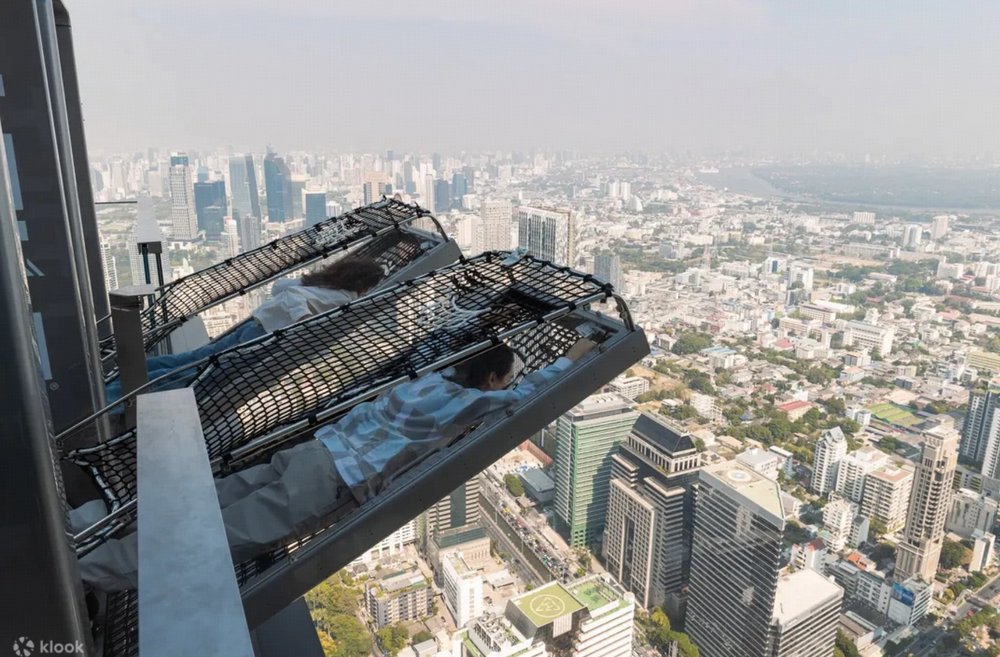
Mahanakhon SkyWalk, Bangkok
Bangkok drains batteries fast. Maps and ride-hailing apps run all day, so top up before you head out. If you're still planning, our things to do in Bangkok guide has plenty of ideas, and the Bangkok page lists what's bookable.
Getting around is the first battery drain, since you'll check the route on your phone at every station. The BTS Skytrain Rabbit Card lets you tap through gates without digging for coins, which saves you from fumbling with your phone. It suits first-timers riding the Skytrain several times a day.
Photos are the second drain. The glass floor at the Mahanakhon SkyWalk is a camera-roll magnet, so go in with a full battery. At Sea Life Bangkok, kids will want your phone for videos, which makes it a good place to bring a spare cable and power bank.
Temple days are the hardest on a phone. At the Grand Palace, you'll be on your feet for hours, and your phone will be your camera and your map.
Evenings on the water are the easy ones. The Chao Phraya White Orchid cruise is a calm way to end the day, but don't count on a spare socket on board. Charge fully beforehand.
Forgot your adapter? Where to buy one in Thailand
You can buy a plug adapter in Thailand, and it won't take long. Electronics shops and mall tech counters in Bangkok usually stock them. The downside is quality, since the cheapest ones feel flimsy in a loose socket.
For a wider choice, head to Chatuchak Weekend Market. Stalls there sell chargers, cables and phone accessories, and you can compare options in one trip. It's mainly open on weekends, so plan around that if you land midweek.
FAQs about Thailand plug type
What plug type does Thailand use?
Thailand uses Type C and Type O as its official plug types, and most sockets are hybrids that also take Type A and Type B. That's why a US or EU charger usually fits without an adapter. Some older outlets can be a loose fit, so the Thailand plug type on your charger matters less than a firm adapter.
What is the voltage in Thailand?
The standard Thailand voltage is 230V at 50Hz, though many guides round it to 220V. That's about double the 120V used in the US and Canada. Check your charger label for "100-240V" to make sure it can handle the difference.
Do I need a power adapter for Thailand?
It depends on your plug. UK and Australian plugs need an adapter, since Type G and Type I don't fit Thai sockets. US and EU plugs usually fit, but a universal adapter is a cheap backup for loose or unusual outlets.
Do I need a voltage converter in Thailand?
Only if your device is single-voltage. Phones, laptops, tablets and cameras are almost always dual-voltage, so they need no converter. Hair dryers, straighteners and some shavers are the usual exceptions, so check the label first.
Can I use my US plug in Thailand?
Yes, in most cases. Type A and Type B plugs fit the hybrid sockets found in most hotels and homes. The catch is the voltage: if your device says 120V only, a converter is needed to avoid damage.
Do Thai hotels have universal sockets?
Many mid-range and higher hotels in Bangkok do, and some add USB ports as well. Budget guesthouses and hostels vary, so bring your own adapter to be safe. A model with USB ports saves you hunting for a free wall socket.
Can I buy a plug adapter in Thailand?
Yes. Electronics shops and malls usually stock them, and so do stalls at Chatuchak Weekend Market. Quality varies, so it's worth buying a sturdy one before you fly if you can.
Plug in, power up and go
Soon you'll be on a Skytrain platform with a charged phone, a working signal and the right plug in your bag. Knowing your Thailand plug type is the whole plan, and it takes one evening to sort. Check the labels on your chargers tonight, drop an adapter in your carry-on, and set up your Thailand eSIM so your phone has power and signal from day one.
More Thailand and plug guides for you


What is Klook?
Klook is a leading pan-regional experiences platform in Asia Pacific, purpose built to digitalize experiences and make them accessible to every traveler.
Our mission is to build the digital infrastructure for the global experience economy — empowering merchants to share their passions and travelers to discover the heartbeat of each destination. We operate a mobile-first, curated platform featuring diverse experiences across global destinations.