


Most people come to Rome for the Colosseum, the Vatican, and the Trevi Fountain. And look, those are great. But Rome is a city built on top of itself, layer by layer, across nearly 3,000 years of history. That means there's a whole other city waiting just beneath the surface and scattered across its streets that most tourists never get close to.
The weird things to do in Rome are often the most memorable ones. Rooms decorated with human skulls, a pyramid in the middle of the city, an emperor's buried palace you can walk through, and so many other places that tell Rome's most compelling, strange, and surprising stories.
This guide is organized by the type of unusual experience you're after, so you can pick the kind of strange that suits you best!
Macabre and underground attractions in Rome
Capuchin Crypt

The bones of 3,700 Capuchin friars displayed in the Capuchin Crypt in Rome
If there's one place that earns its reputation as one of Rome's most unsettling and unusual attractions, it's this one. The Capuchin Crypt is under the Church of Santa Maria della Concezione dei Cappuccini on Via Veneto, and its six small chapels are decorated entirely with the bones of around 3,700 Capuchin friars who died between 1500 and 1870.
For the fullest experience, the Capuchin Crypt and Catacombs of Priscilla tour takes you there after closing time, when the crowds are gone and the atmosphere is something else entirely.
Catacombe di San Callisto

The catacombs in Rome
Most visitors who come to Rome for underground Rome tours don't realize how vast the catacombs really are. The Catacombe di San Callisto stretch for around 20 km beneath the Appian Way on the outskirts of the city.
It’s one of the largest and best-preserved early Christian burial networks in existence, and roughly 500,000 people were buried here over three centuries, including multiple popes and the martyr Saint Cecilia.
What makes it so different from a standard museum visit is the scale and the darkness. You descend with a guide through narrow tunnels lined with niches carved into the rock, past ancient frescoes and Greek inscriptions, into a world that was kept completely secret for hundreds of years.
For a combined experience that pairs the catacombs with the bone crypt, the catacombs underground tour covers both in a single guided visit.
Domus Aurea (Nero's buried golden palace)

The ceiling paintings in Domus Aurea | Photo by Andy Montgomery on Wikimedia
In 64 AD, Emperor Nero built himself a pleasure palace so enormous it reportedly covered a third of the city. After his death, succeeding emperors buried it and built over it, including the Colosseum, which is on land that was once Nero's private lake.
The Domus Aurea was lost for centuries until Renaissance artists discovered its frescoed rooms by accident and lowered themselves in through holes in the ground. Those painters, including Raphael, were so inspired by the ceiling paintings they found that the style influenced Renaissance art for generations.
Today, you can walk through the excavated rooms on a guided tour, some of which are accessed via a virtual reality experience that reconstructs the palace's lost grandeur. It's one of Rome's most fascinating off-the-beaten-path sites.
The Colosseum ticket with VR show gives you a similar immersive experience next door if you want to layer the ancient history with modern technology.
Architectural oddities and curiosities in Rome
Pyramid of Cestius
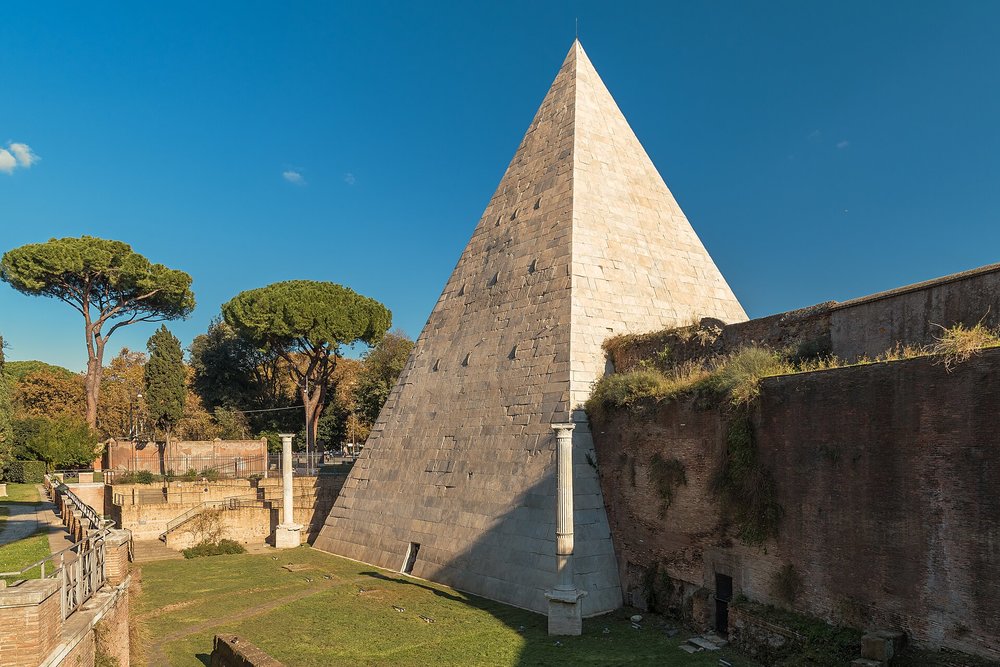
The Pyramid of Cestius in Testaccio, Rome | Photo by Rabax63 on Wikimedia
One of Rome's most surprising sights, the Pyramid of Cestius is a fully intact ancient Egyptian-style pyramid standing 36 meters tall right in the middle of the city near Porta San Paolo. It was built as a tomb for Gaius Cestius, a Roman magistrate, around 12 BC.
The Pyramid of Cestius is unusual because it feels completely out of place, and yet it's been there for over 2,000 years. It's now incorporated into the ancient city walls and can be visited on guided tours. The interior contains well-preserved frescoes and is only accessible on weekends with advance booking.
Palazzo Zuccari and the monster door

The monster door of Palazzo Zuccari, Rome | Photo by Effems on Wikimedia
On Via Gregoriana, just a short walk from the top of the Spanish Steps, stands the Palazzo Zuccari, a 16th-century palazzo whose entrance is carved in the shape of a giant open mouth. The door, windows, and surrounding stonework form a monster's face, with the entrance passage functioning as its gaping mouth.
The palazzo was designed in 1590 by the painter Federico Zuccari and later became home to figures including Queen Christina of Sweden and Winckelmann, the art historian who helped invent archaeology as a discipline. It now houses an art library and isn't open to general visitors, but the facade alone is worth the detour.
Unique historical sites and experiences
Museo delle Anime del Purgatorio

Sculpture outside the Church of the Sacred Heart of Suffrage | Photo by Matt Kieffer on Flickr
This is one of the strangest rooms in Rome, and almost no one knows it exists. The Museo delle Anime del Purgatorio (Museum of the Souls in Purgatory) occupies a single small room inside the Church of the Sacred Heart of Suffrage on the Tiber, near Castel Sant'Angelo. The collection consists of objects said to bear the fingerprints and burn marks of souls in purgatory.
The items, like nightcaps, prayer books, and table covers, date from the 18th and 19th centuries and come with handwritten case files explaining each apparition. Whether you find it historically fascinating, theologically interesting, or simply one of the most bizarre rooms you've ever stood in, it's unlike anywhere else in the city.
Ostia Antica

The Ostia Antica in Rome
About 30 km from the city center, Ostia Antica was Rome's ancient harbor city, the same port through which the entire Roman world's trade passed for centuries. It was abandoned in the medieval period and covered by silt and sand, which preserved it almost perfectly.
Today it's an open-air archaeological site where you can walk along actual ancient Roman streets, step into preserved taverns and bakeries, read election graffiti on walls, and visit a 4,000-seat theater that still hosts performances.
The Colosseum and the gladiator training experience

Join a gladiator training experience in Rome, near the Colosseum
For a different kind of historical encounter, the Gladiator training experience in Rome takes place in a reconstructed gladiatorial school near the Colosseum. Certified instructors (historians in Roman gladiatorial combat techniques) teach you the actual fighting forms used in the arena: how to move, how to hold a shield, and how to strike.
What makes it unusual, rather than just a tourist activity, is the level of historical detail. The school uses documented evidence from ancient sources to reconstruct gladiatorial training methods, and you’ll leave with a clear sense of how much skill and athleticism the games actually required.
FAQs about Rome’s unusual attractions
What are the most unusual things to see in Rome?
Rome's most unusual attractions include the Capuchin Crypt, where the remains of 3,700 Capuchin friars decorate six underground chapels; the Pyramid of Cestius, a 2,000-year-old ancient Egyptian-style tomb in the middle of the city; and the Domus Aurea, Nero's buried golden palace that was lost beneath the city for centuries.
What is the Capuchin Crypt, and is it worth visiting?
The Capuchin Crypt is a series of six small chapels beneath the Church of Santa Maria della Concezione dei Cappuccini on Via Veneto, decorated entirely with the bones of around 3,700 Capuchin friars who died between the 16th and 19th centuries.
Are there underground tours in Rome?
Yes! Underground Rome tours are some of the best experiences the city offers. The Catacombe di San Callisto extend for roughly 20 km beneath the Appian Way and date back nearly 2,000 years. The Domus Aurea lets you walk through the excavated rooms of Nero's buried palace beneath the Oppian Hill.
Other underground options include the Basilica di San Clemente, where you can descend through three layers of history to a first-century Roman street, and various aqueduct and tunnel tours. A combined underground tour with catacombs and a bone crypt is one of the most efficient ways to see several of these sites in a single visit.
What are the strangest museums in Rome?
The Museo delle Anime del Purgatorio is one of the strangest museums in the city: a small collection inside a church near Castel Sant'Angelo displaying objects said to bear the burn marks and handprints of souls in purgatory, each with a handwritten case file. It's free, almost always empty, and unlike any other museum you'll visit.
What are the most bizarre historical sites in Rome?
The Pyramid of Cestius is perhaps the most bizarre: a full-scale ancient pyramid beside a metro station, built in 12 BC by a Roman official who had clearly become very interested in Egypt. The Palazzo Zuccari's monster door on Via Gregoriana is another standout: a 16th-century entrance carved in the shape of a giant open mouth.
Plan your weird and wonderful Rome trip!
The headline attractions of Rome are worth seeing, yes, but the city's strangest sites, from bone-decorated crypts to buried palaces to pyramids hiding in plain sight, are often the ones you’ll remember the most from your trip.
For more on what Italy has to offer beyond the usual itinerary, start with Rome and keep going!
More Rome travel guides for you


What is Klook?
Klook is a leading pan-regional experiences platform in Asia Pacific, purpose built to digitalize experiences and make them accessible to every traveler.
Our mission is to build the digital infrastructure for the global experience economy — empowering merchants to share their passions and travelers to discover the heartbeat of each destination. We operate a mobile-first, curated platform featuring diverse experiences across global destinations.