About the event
Science and Art Calligraphy Exhibition 2023 Information
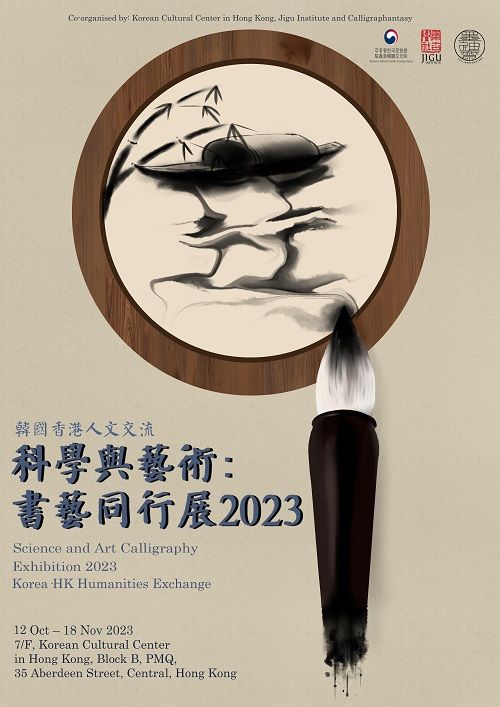
The Silla Kingdom of Korea had long enjoyed close ties with the Tang dynasty of China. Many Korean students studied abroad in China at that time and the most celebrated one was Choe Chiwon. He stayed in China for almost 18 years and was dispatched to Yang Zhou in China to assist in military and political administration for four years. Many historical East Asian texts and stone steles still have records of his literary works and footprints in China.
“Science and Art Calligraphy Exhibition 2023” originates from the Calligraphy Connections Project. This exhibition invites renowned scholars and students from different disciplines to create calligraphy artworks works which are inspired by the rarely used Collection of Korean Anthologies (which are now archived in the Library of the City University of Hong Kong) and stone steles about Choe Chi-won. Most students’ calligraphy artworks were chosen to reflect Choe Chiwon’s footprints in China and Korea.
In addition, this exhibition will showcase the award-winning translation works of the JC Poetic Translation Awards 2023 which was organized by the Department of Linguistics and Translation, City University of Hong Kong. The poem for translation awards this year is authored by Choe Chi-won and attracted many students from the City University of Hong Kong and secondary school students in Hong Kong to participate. It is hoped that the translation works will transcend the language boundaries so that more audiences can appreciate the beauty of ancient Korean poems. Bo Mu from the College of Liberal Arts and Social Sciences (City University of Hong Kong) has taken a step further and applied text-mining techniques to visualize the differences between poems authored by Choe Chi-won (from Korea) and Li Bai (from China). He finds that Choe Chiwon’s poems are mainly themed on “鄉” (Hometown) and “雲” (Cloud). This is not surprising given that Choe Chiwon left his hometown for China for many years and his literary name was “孤雲” (Lonely Cloud; Hanguel: 고운). Li Bai’s poems, on the other hand, are themed on “我” (myself). A more detailed explanation will be provided in the exhibition.
Choe Chiwon’s literature was also recorded on stone steles, such as the Epitaph of the Monument for Esteemed Priest Jingam at Ssanggyesa Temple (National Treasure No. 47; Accession Number of National Museum of Korea - Bongwan 590). This stone stele was carved for Master Jingam (773-850) who died at Ssanggyesa Temple. King Munseong of Silla ordered the establishment of this stele and bestowed a name for it. The stele is presumed to have been erected in 887, and its epitaph, which was composed by Choe Chi-won, introduces the achievements of Master Jingam. Eleanor Guo from the Department of Linguistics and Translation (City University of Hong Kong) has tried translating selected paragraphs of the epitaph (in Classical Chinese) into modern Chinese so that people nowadays can understand. Richard Wong has also attempted to mimic the calligraphy on the stone stele, so that it may become easier for the audience to appreciate ancient Korean scholar’s calligraphy in ink.
It is hoped that the community can reflect on the wisdom brought by Choe Chiwon in modern society and Korean and Chinese can continue the humanities exchange which has been going on for more than 1000 years.
Zixuan Hao and Richard Wong
Exhibition details
- Science and Art Calligraphy Exhibition 2023
- Date: October 12-November 18, 2023
- Time: 10am to 6pm (Tue to Sat)
- Location: Korean Cultural Center in Hong Kong
- Address: 6th Floor, Tower B, PMQ, 35 Aberdeen Street, Central, Hong Kong
Information Source: Official website of the Korean Cultural Center in Hong Kong