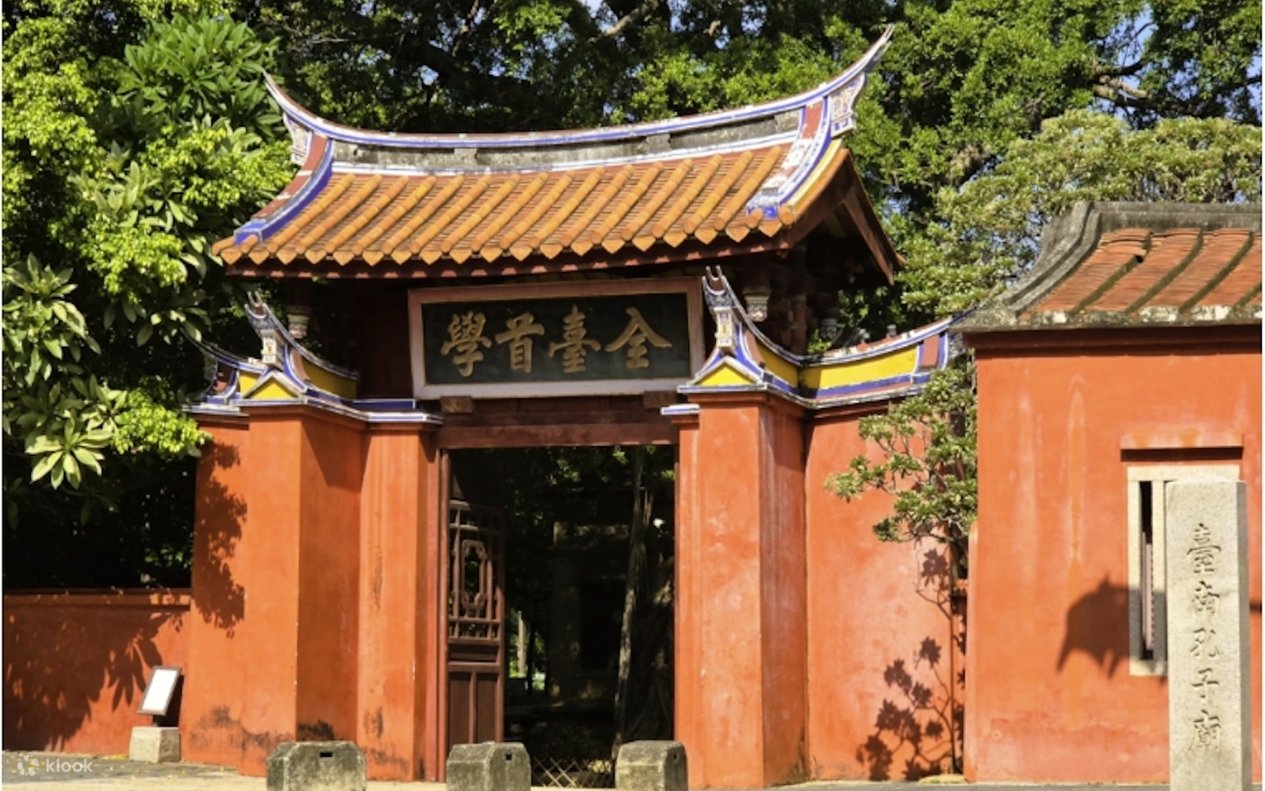
Tainan Confucius Temple, a national historic site built in 1665, is not only the first official school in Taiwan's history but also enjoys the reputation of "Taiwan's First Academy." This architectural complex, featuring a school on the left and a temple on the right, served as an important place for cultivating national talents and educating scholars during the Ming Zheng and Qing dynasties, carrying profound historical and cultural heritage.
Tainan Confucius Temple: Taiwan's First Academy, a Century of Unfading Scholarly Tradition
Taiwan's First Confucius Temple in Tainan
In the 19th year of Yongli of the Ming Dynasty (1665 AD), during the reign of Zheng Jing, the son and successor of Koxinga, Chen Yonghua, the Counselor and Military Advisor, assisted in governance and diligently worked to strengthen the state. He proposed: “We must choose a site to establish a sacred temple and schools to gather talents; for if a nation has virtuous scholars, its foundation will be solid, and its fortunes will prosper daily.”
Zheng Jing agreed, and thus the Confucius Temple was built in Chengtian Prefecture (present-day Tainan City) to worship Confucius, promote national education, and carry out moral instruction.
For over three hundred years, the majestic sacred hall and grand academy have symbolized the continuous transmission of Chinese culture and the enduring fragrance of ancestral worship, earning the elegant reputation of “Zoulu by the Sea.”
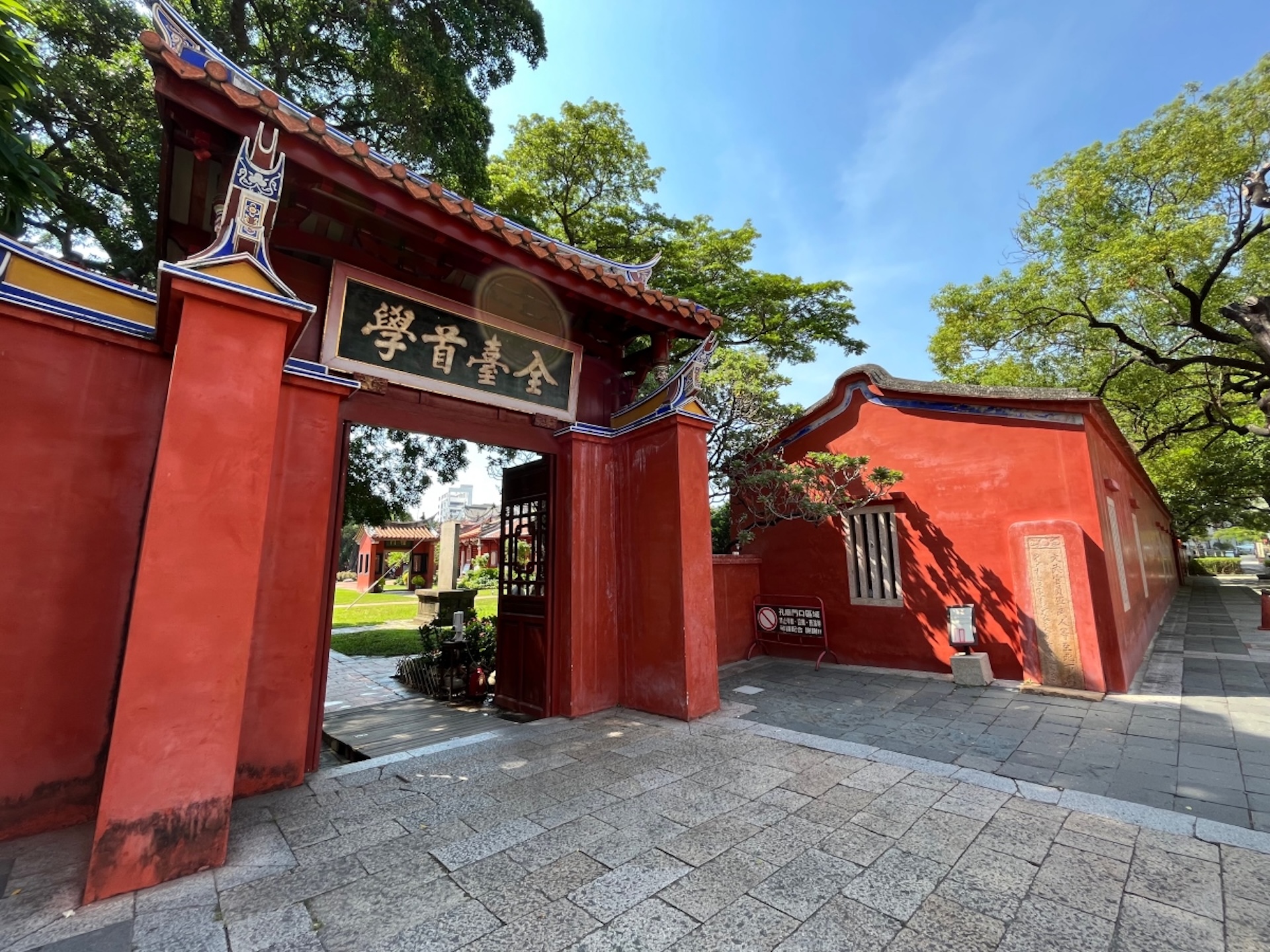 ▲ Taiwan’s First Academy
Taiwan's First Academy - Dacheng Gate
The name “Dacheng Gate” comes from Confucius’s title “Great Accomplishment, Most Holy Ancient Teacher,” and also carries the meaning of praising his sacred virtue.
The gate is in the form of a gate tower, with cross-shaped load-bearing walls increasing stability. Six swallowtail ridges fly up from the front, back, left, and right of the wall top, supported by dougong (bracket sets) to form a xieshan-style roof. Above the gate hangs a plaque inscribed “Taiwan’s First Academy,” truly echoing the reputation of Taiwan’s first Confucius Temple.
A “Dismounting Stele” is embedded in the left wall of the Dacheng Gate, greeting visitors. Walls surround the temple on its sides, tall and red. Confucius was a man of the Zhou Dynasty, and red was revered at that time; official attire and palace buildings were all adorned with noble red, and so too were the walls of the Confucius Temple.
 ▲ Dismounting Stele
The high wall is also called “Palace Wall,” derived from an anecdote in the Analects: Zigong compared scholarship to a palace wall, saying his own wall was shoulder-high, while Confucius’s wall was several ren high (one ren is seven chi, so several ren is already towering). Later generations used “Ten Thousand Ren Palace Wall” to extol Confucius’s profound knowledge and moral character, and thus the palace wall became a standard feature of Confucius Temples.
Passing through the Pan Gong Stone Archway and the Ten Thousand Ren Palace Wall, one enters the East Dacheng Gate, gaining a glimpse of its profound beauty.
One sees a spacious and open area with ancient trees reaching to the sky, and the beautiful name “Apricot Altar Summer Shade” spreads far and wide. The side of the archway used to house official offices and a local deity shrine, but due to long-term disuse and dilapidation, it has now been converted into an “Exhibition Room for Cultural Relics,” with a caretaker’s office nearby.
▲ Dismounting Stele
The high wall is also called “Palace Wall,” derived from an anecdote in the Analects: Zigong compared scholarship to a palace wall, saying his own wall was shoulder-high, while Confucius’s wall was several ren high (one ren is seven chi, so several ren is already towering). Later generations used “Ten Thousand Ren Palace Wall” to extol Confucius’s profound knowledge and moral character, and thus the palace wall became a standard feature of Confucius Temples.
Passing through the Pan Gong Stone Archway and the Ten Thousand Ren Palace Wall, one enters the East Dacheng Gate, gaining a glimpse of its profound beauty.
One sees a spacious and open area with ancient trees reaching to the sky, and the beautiful name “Apricot Altar Summer Shade” spreads far and wide. The side of the archway used to house official offices and a local deity shrine, but due to long-term disuse and dilapidation, it has now been converted into an “Exhibition Room for Cultural Relics,” with a caretaker’s office nearby.
 ▲ Dacheng Hall
Left School, Right Temple - The Architectural Layout of the Confucius Temple
The Confucius Temple is abbreviated as “Confucius Temple,” also known as “Wenmiao” (Temple of Culture) or “Xianshi Miao” (Temple of the First Teacher).
This temple is a traditional courtyard building with three courtyards and two wings, gradually developed according to the “left school, right temple” and “front hall, rear pavilion” palace-style regulations.
However, after numerous reforms, vicissitudes, and the passage of time, some buildings were destroyed by natural disasters or wars, such as the Zhuzi Ancestral Hall, Lingxing Gate, Professor’s Office, and Academy Office, all of which have disappeared without a trace, leaving only empty spaces.
What is seen today largely reflects the appearance after the major renovation in the sixth year of Taisho (1917 AD) during the Japanese occupation. It generally maintains the style and regulations of the Qing Dynasty, making it the first Confucius Temple in Taiwan and the most representative traditional Southern Min-style architecture.
Minglun Hall
“Left school” refers to Minglun Hall, located to the left of the Dacheng Hall of the Confucius Temple, which was the site of the Taiwan Prefectural School. In the past, students who passed the entrance examination received guidance from the prefectural school professors here, cultivating character, diligently studying, and discussing policies.
The three-door archway of Minglun Hall bears horizontal plaques inscribed with “Gate of Virtue,” “Sacred Realm,” and “Gate of Sages.” Students, looking up as they pass through this gate, are subtly influenced by the space, naturally fostering the Confucian pursuit of moral cultivation and the aspiration to become a sage.
 ▲ Minglun Hall
Dacheng Gate and Dacheng Hall
Among the Confucius Temple’s architectural complex, the Dacheng Gate is the most ornate. Its distinctive feature of not having couplets on the pillars is to avoid the ridicule of “showing off one’s literary skills before Confucius.”
Each pair of door panels is adorned with one hundred and eight door studs. Since “nine” is the ultimate yang number, its multiple represents the majesty and reverence of the sacred temple, and the honor of being accorded imperial status.
The main ridge of Dacheng Hall has “Tibetan Scripture Cylinders” at both ends; also known as “Heaven-Connecting Pillars,” they symbolize Confucius’s virtue matching heaven and earth, and his wisdom pervading past and present.
Eight bells hang from the eaves’ four corners, symbolizing that heaven would use Confucius as a wooden clapper to awaken and inspire the world.
A terrace is set in front of the hall, where the six-row dance of the Confucius worship ceremony is performed. Carved stone “water-draining chi-shou” are embedded in the four corners of the platform base, serving as drainage outlets for the terrace and corridors; the chi-shou resembles a dragon’s head, also known as “ao-shou,” conveying the aspiration for success, “monopolizing the ao-shou” (being first in imperial examinations), and the implicit meaning of “benefiting all directions.”
“East Wing” and “West Wing” are the side rooms located to the left and right of the Dacheng Hall. The ritual vessel storage and musical instrument storage are in the rear halves of the left and right wings, respectively. The rear hall was originally called “Qisheng Ancestral Hall,” dedicated to Confucius’s father, Shu Liang He.
The left room is “Yicheng Academy,” responsible for matters related to the spring and autumn Confucius worship. The right room was originally the “Classics Room.” The rear hall is the end of the “right temple,” and through the eaves corridor, one can return to the “left school” space.
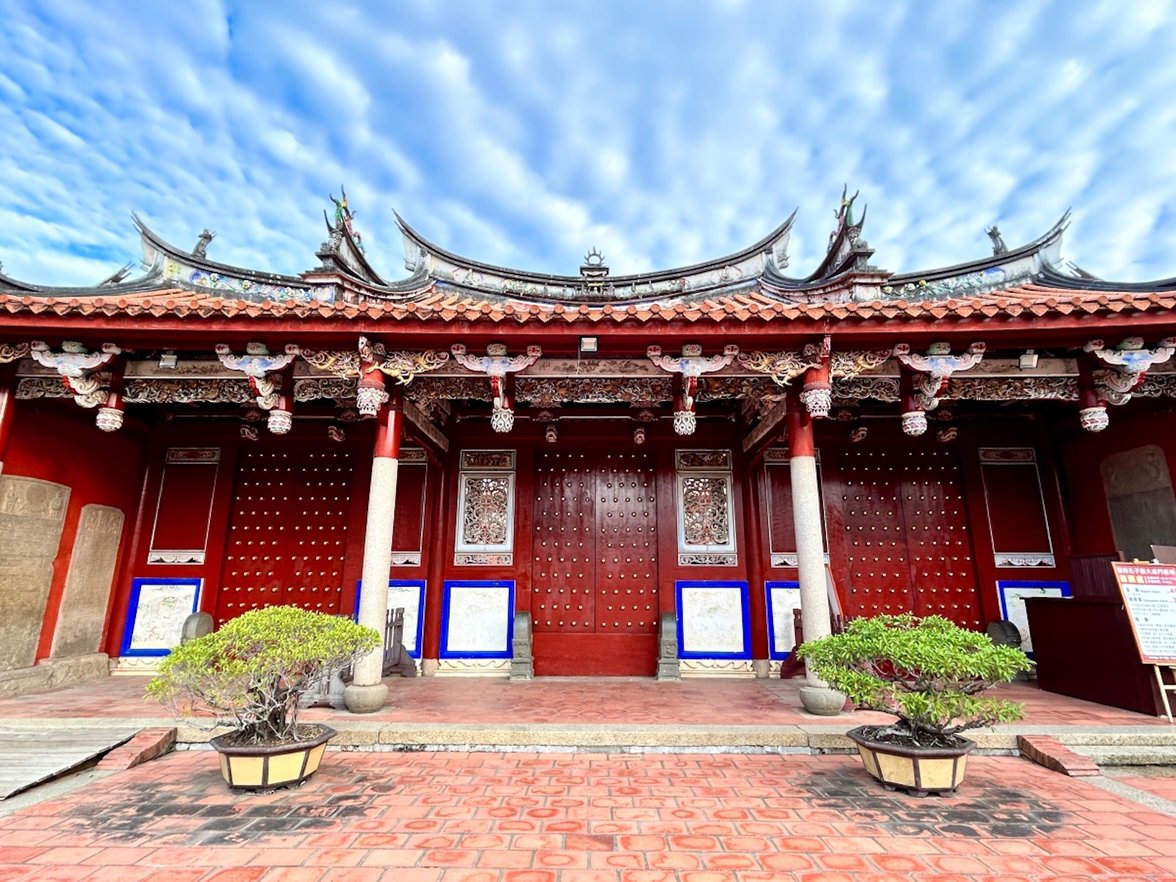
▲ Dacheng Gate
Wenchang Pavilion
Wenchang Pavilion, also known as “Kuixing Tower,” is located behind and to the left of Minglun Hall, and is the only tower-like building in the Confucius Temple architectural complex.
 ▲ Wenchang Pavilion
Pan Gong Stone Archway
The two characters “Pan Gong” symbolize the location of an academy. Students who passed the county examination and were admitted to the academy (Pan Gong) were called “shengyuan” (government students). “Entering Pan,” “Touring Pan,” “Gathering Celery,” or “Wandering in Pan Shui” all refer to students entering the academy.
The “Pan Gong Stone Archway” was originally the outermost entrance to the Tainan Confucius Temple. During the Japanese occupation, it was moved eastward due to the construction of Nanmen Road. It now faces the “Taiwan’s First Academy” Dacheng Gate of the Confucius Temple across Nanmen Road.
 ▲ Pan Gong Stone Archway