Shan Tang Jie, Gu Su Qu, Su Zhou Shi, Jiang Su Sheng, Chine
Avis
Guide
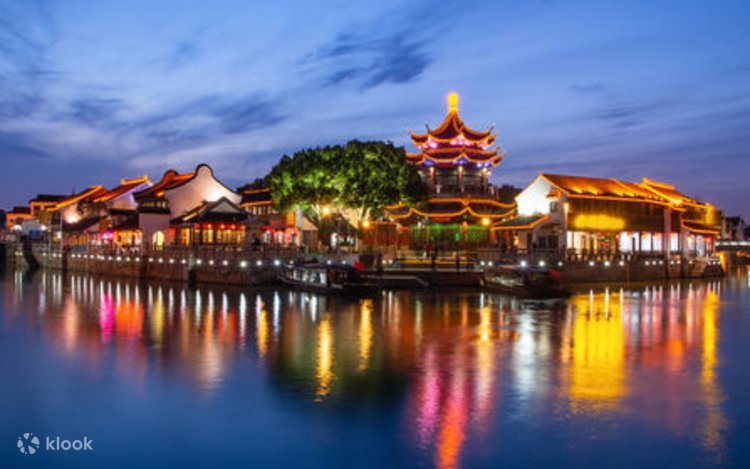
Shantang Street runs from the northwest end at Tiger Hill to the southeast end at Chang Gate. The street parallels Shantang River, with ancient bridges spanning the river. Old houses with white walls and black tiles and numerous shops line both sides of the stone-paved street. At night, the lit red lanterns are reflected in the river, making it a great spot for taking photos. You can also take a cruise, or find a teahouse to drink tea and listen to Pingtan.
Shantang Street runs from southeast to northwest, with a total length of about seven li, hence the name "Seven Li Shantang". Shantang Street has a thousand-year history. It was built under the direction of Bai Juyi, a poet of the Tang Dynasty, when he was an official in Suzhou. Now, at the southern end of the street, you can see the Bai Gong Ancestral Hall, built by the people to commemorate Bai Juyi. Emperor Qianlong of the Qing Dynasty had a special fondness for Seven Li Shantang. The imperial stele pavilion with his own handwriting "Seeking Scenery in Shantang" is still well preserved. There are also ancient sites such as archways, ancestral halls, and guilds. There are more than a dozen guilds, which were once the resident offices of foreign chambers of commerce in Suzhou, mostly built in the mid-Qing Dynasty.
The southeast section of Shantang Street, which is close to Chang Gate, is known as "Shantang Old Street", which is about 360 meters long. This section has a high density of shops, gathering various handicraft shops and snack shops, as well as major attractions such as Yuhan Hall, Antai Fire Brigade, Tonggui Bridge, Suzhou Chamber of Commerce Museum, and the ancient opera stage. It is the most commercial and touristy part of the entire street.
Yuhan Hall is the former residence of Wu Yipeng, Minister of the Ministry of Personnel in the Ming Dynasty. It is an ancient architectural complex outside Suzhou city. This building brings together various forms of Chinese rooms such as halls, rooms, buildings, pavilions, and studios. You can feel the strong cultural and artistic characteristics of the Ming Dynasty through the carved beams and painted pillars here.
Tonggui Bridge is an arched stone bridge spanning Shantang River. It is a good place to enjoy the water town scenery of Suzhou, and it is also a classic location for oil paintings and watercolors. You can often see people painting carefully on the bridge, and in the early years, award-winning movies such as "Meihua Jin" and "Hongfen" were also filmed here.
There are many traditional food shops on Shantang Street, including large restaurants such as Songhelou, as well as affordable and delicious snack shops such as Rongyanglou and Xinnian Dim Sum Shop, as well as Huang Tianyuan Cake Shop and Caizhizhai Candy Shop. You can taste traditional snacks such as plum blossom cake, crabapple cake, and red bean paste sweet porridge. There are also many folk crafts shops selling antiques, calligraphy, paintings, carvings, and paper cuttings.
Shantang Street runs from the northwest end at Tiger Hill to the southeast end at Chang Gate. The street parallels Shantang River, with ancient bridges spanning the river. Old houses with white walls and black tiles and numerous shops line both sides of the stone-paved street. At night, the lit red lanterns are reflected in the river, making it a great spot for taking photos. You can also take a cruise, or find a teahouse to drink tea and listen to Pingtan.
Shantang Street runs from southeast to northwest, with a total length of about seven li, hence the name "Seven Li Shantang". Shantang Street has a thousand-year history. It was built under the direction of Bai Juyi, a poet of the Tang Dynasty, when he was an official in Suzhou. Now, at the southern end of the street, you can see the Bai Gong Ancestral Hall, built by the people to commemorate Bai Juyi. Emperor Qianlong of the Qing Dynasty had a special fondness for Seven Li Shantang. The imperial stele pavilion with his own handwriting "Seeking Scenery in Shantang" is still well preserved. There are also ancient sites such as archways, ancestral halls, and guilds. There are more than a dozen guilds, which were once the resident offices of foreign chambers of commerce in Suzhou, mostly built in the mid-Qing Dynasty.
The southeast section of Shantang Street, which is close to Chang Gate, is known as "Shantang Old Street", which is about 360 meters long. This section has a high density of shops, gathering various handicraft shops and snack shops, as well as major attractions such as Yuhan Hall, Antai Fire Brigade, Tonggui Bridge, Suzhou Chamber of Commerce Museum, and the ancient opera stage. It is the most commercial and touristy part of the entire street.
Yuhan Hall is the former residence of Wu Yipeng, Minister of the Ministry of Personnel in the Ming Dynasty. It is an ancient architectural complex outside Suzhou city. This building brings together various forms of Chinese rooms such as halls, rooms, buildings, pavilions, and studios. You can feel the strong cultural and artistic characteristics of the Ming Dynasty through the carved beams and painted pillars here.
Tonggui Bridge is an arched stone bridge spanning Shantang River. It is a good place to enjoy the water town scenery of Suzhou, and it is also a classic location for oil paintings and watercolors. You can often see people painting carefully on the bridge, and in the early years, award-winning movies such as "Meihua Jin" and "Hongfen" were also filmed here.
There are many traditional food shops on Shantang Street, including large restaurants such as Songhelou, as well as affordable and delicious snack shops such as Rongyanglou and Xinnian Dim Sum Shop, as well as Huang Tianyuan Cake Shop and Caizhizhai Candy Shop. You can taste traditional snacks such as plum blossom cake, crabapple cake, and red bean paste sweet porridge. There are also many folk crafts shops selling antiques, calligraphy, paintings, carvings, and paper cuttings.