Photos
About the event
George Byrne: Infinite City | Exhibition Information
George Byrne's Wonderland
Written by LAN Chung-Hsuan (Artist / Curator)
Ever since the first photograph taken by Nicéphore Niépce, and the devising of Daguerreotype—a method established by Louis Daguerre, the possibility of what photography could be has been expanding: from the fact-manipulating photojournalism; to the dark and outlandish shi-shashin (私写真); to the diverse utilization of images in conceptual art; to the ever-so-ubiquitous smart phone snapshots. The more popular the technology, credos and methodologies of photography get, the more complicated becomes the question of how photography as a medium today can still serve as a means to our ends.
Between the emergence of Daguerreotype in the 1840s and the prevalence of photography today, was an industrial period, during which not only was the scene of urbanization documented by photography, but also the atmosphere of the metropolitan. The works of Eugène Atget’s old Paris and Alfred Steieglitz’s old New York served as the perfect examples of this, where beyond the visual presentation of each cityscape, the aura of the cities to this day still beams through our retinas and goes into our core. The similar effects of such way of photography (despite the fact that street photos, traveling photos and photojournalisms also captured the urban scene, the unprocessed, uninternalized, and standardized processes are not included in this context) can be found in the Australian photographer George Byrne’s photo collages of Los Angeles.
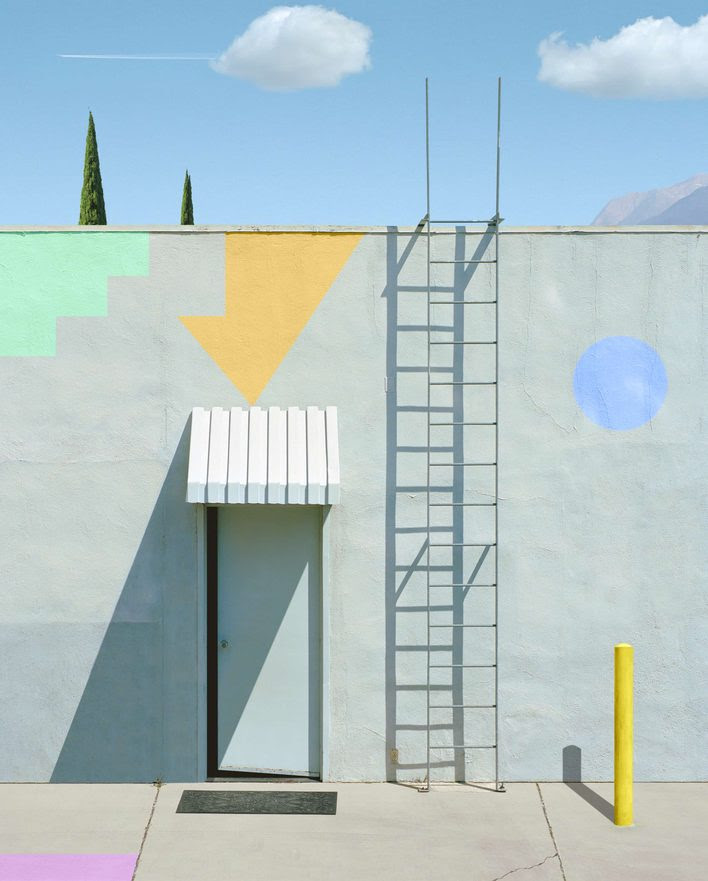
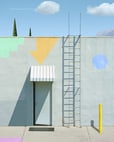
(Blue Circle Eagle Rock, 2021)
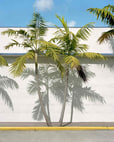
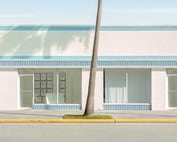
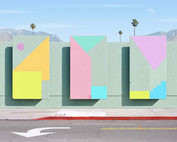
Los Angeles, blessed by the Mediterranean climate with ample sunlight, is known for a sort of harsh lighting particular to the city. George Byrne moved to Los Angeles from Sydney in 2011. Taking advantage of the unique climate in Los Angeles, Byrne developed a series of images that are highly distinctive in style and representative of the city through: the geometric compositions; sturdy buildings and luscious botanicals; the harsh but comforting colors; the cleverly intertextual signs; the rhythmic arrangements of shadows and lights. Upon first impression, these images, showing off the oceanic brightness that the city of angels has to offer, present themselves as meticulously designed retro-posters. Despite their glossy surfaces, the textures of the oil on the walls and their damages slowly become noticeable upon closer examination. The artificiality within these images unveils itself.
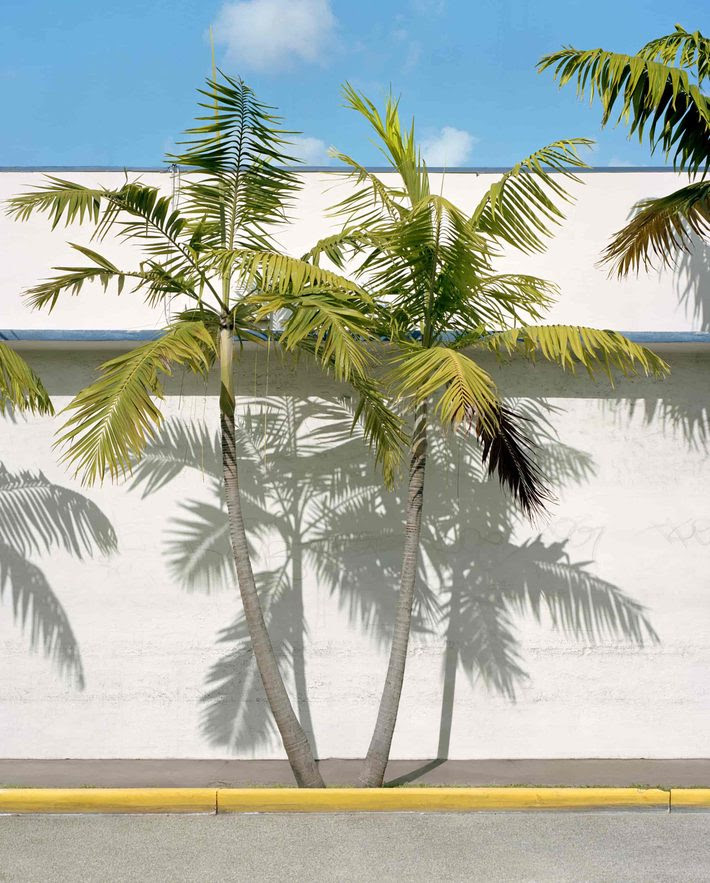
(Bodega Miami, 2021)
Byrne deliberately excluded humans from his works at a moment in time when human’s presence in Los Angeles is endlessly emphasized in our pop culture, Hollywood, Hip-hop, Cali-beaches, multiculturalism—each fragment of Los Angeles we are familiar with, in Byrne’s work is deconstructed and then pieced back together into the same image. When humans do make their rare appearances in Byrne’s works, they are never presented in forms of pure extravagance that is Beverly Hills. Byrne does not eagerly seeks out site and signs of higher class nor does he seem to care for an arrogant take down of the urban site geo-relationality. So, do Byrne’s works really have little to do with humans? On the contrary, the artist himself is the missing link in these photos.
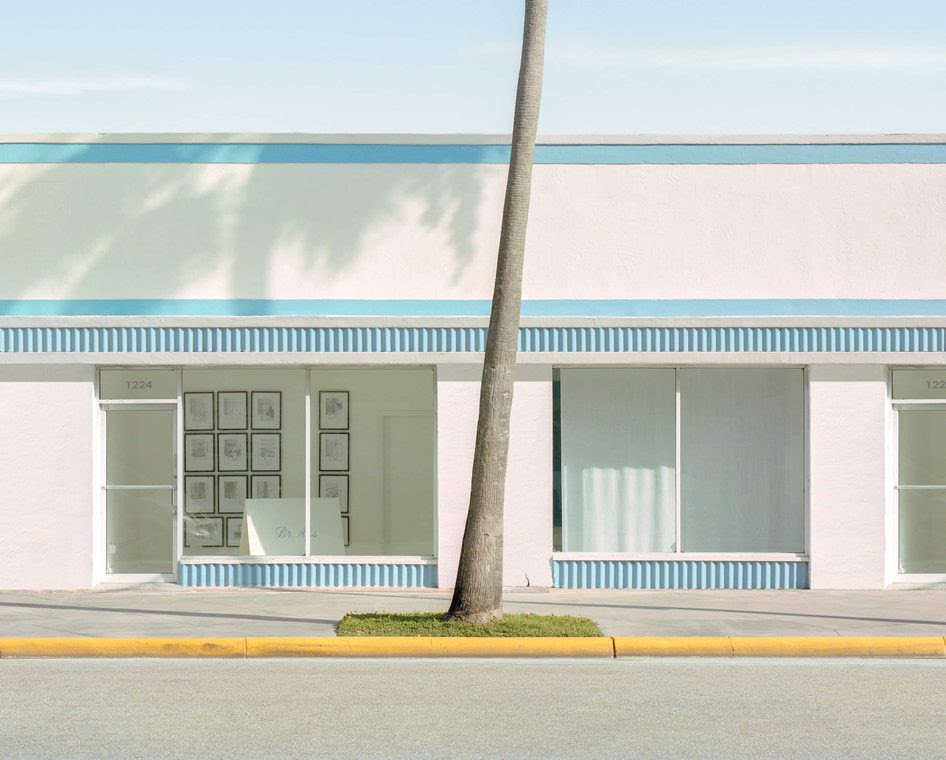
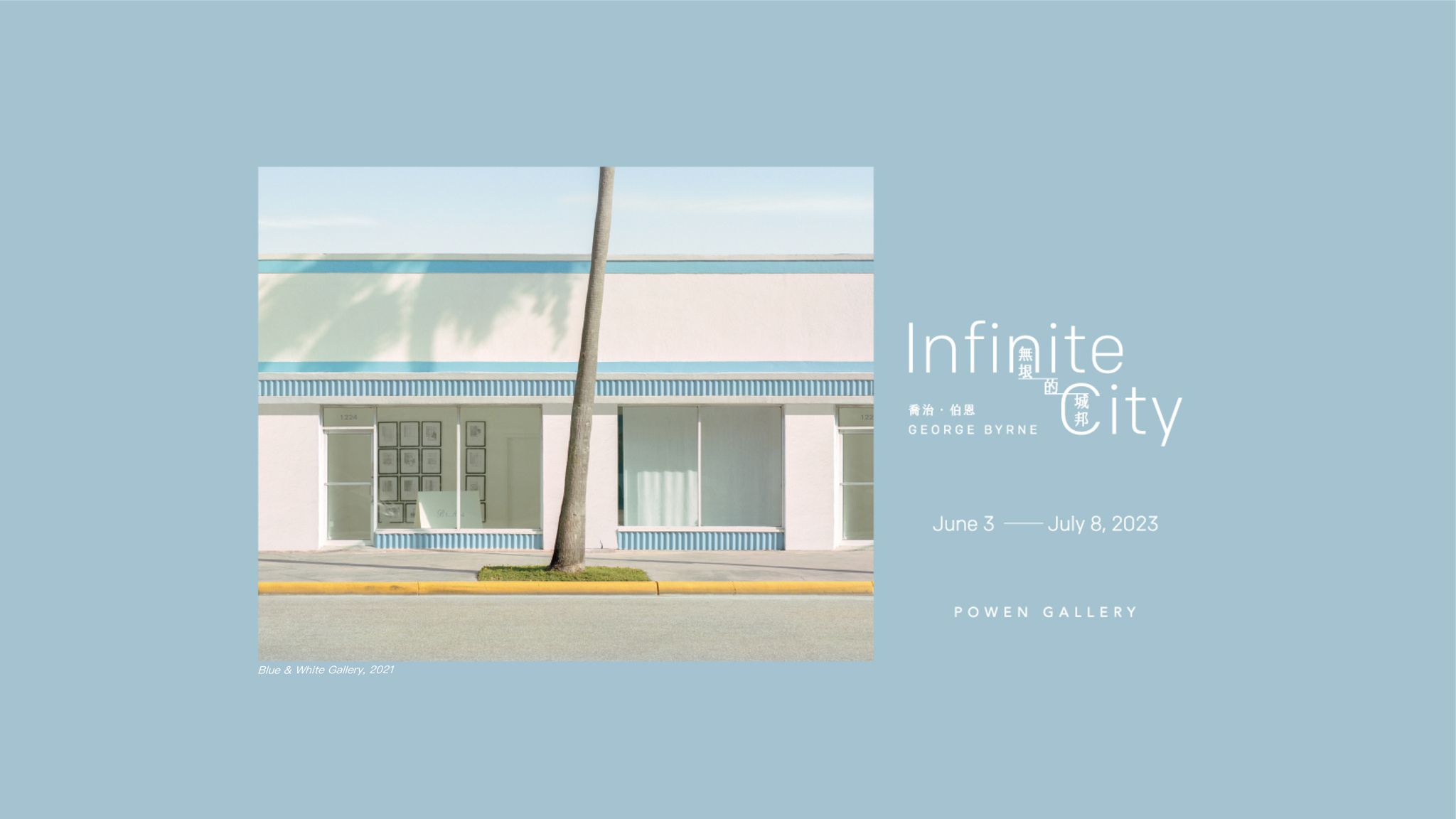
(Blue & White Gallery, 2021)
We have touched on in previous paragraphs how Byrne’s photographed objects reminds us of the presence of human, how the direct traces of human lives are missing from the streets, and that perfection is a deliberate construction. Each fragment included in these images, was the result of Byrne’s observation, his actively seeking out, collecting and planning out the pieces. They are by no means accidental.

(Three Panels Palm Springs, 2021)
Upon this realization, perhaps we find ourselves inclined to deny the artistic connection between him, Atget and Steieglitz, and we find ourselves wanting to preserve a place for Byrne between the new topographics, surrealism, conceptual art and pop art. Nonetheless, excessive rational analysis weakens the intuitive response of the senses. In 2023, where Artificial Intelligence is fully capable of following instructions and generating images of cityscapes with a precision so indelible that we don’t often question which samples these images were made from. From time to time, we even find ourselves enjoying the little errors that occur.
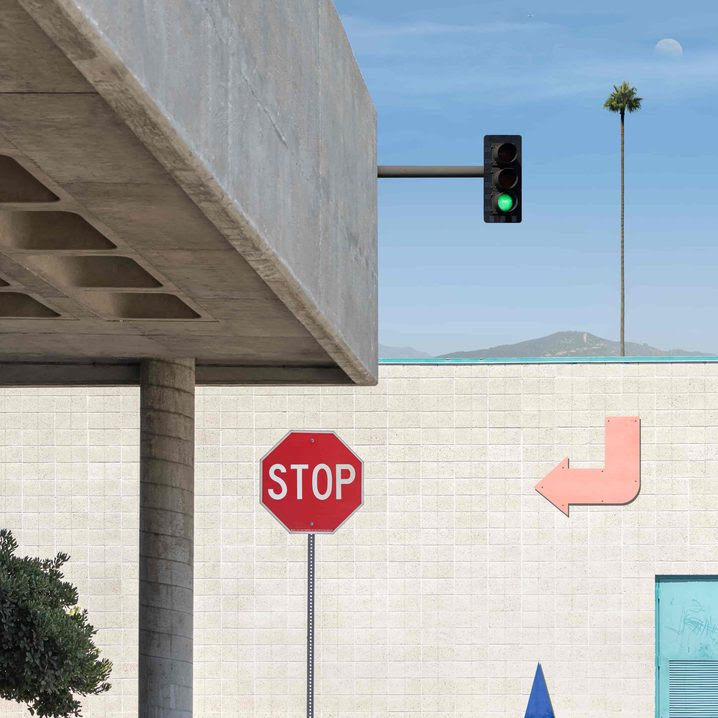
(Bus Depot, 2021)
To conclude, George Byrne’s semi-mythologized Los Angeles, was created from a place of detachment, of photography as a medium from its conventional demand of raw documentation. Byrne’s Los Angeles, by no means a real depiction of the actual city, radiates the energy of a city full of freedom and bright colors. A city that exists in a universe parallel to our own. Photography’s end for Byrne, therefore, becomes self-evident: to construct a wonderland far removed from the messiness of urban sites, within which we anticipate the arrival of such ideal at the next corner.
Exhibition Details
- George Byrne: Infinite City | Exhibition
- Date: 3 June – 8 July 2023
- Time: Tuesday to Saturday 10:00-19:00 (Closed on Sundays and Mondays)
- Venue: Powen Gallery
- Adddress: No. 11, Lane 164, Songjiang Rd, Zhongshan District, Taipei City
Information Source: Powen Gallery|Facebook