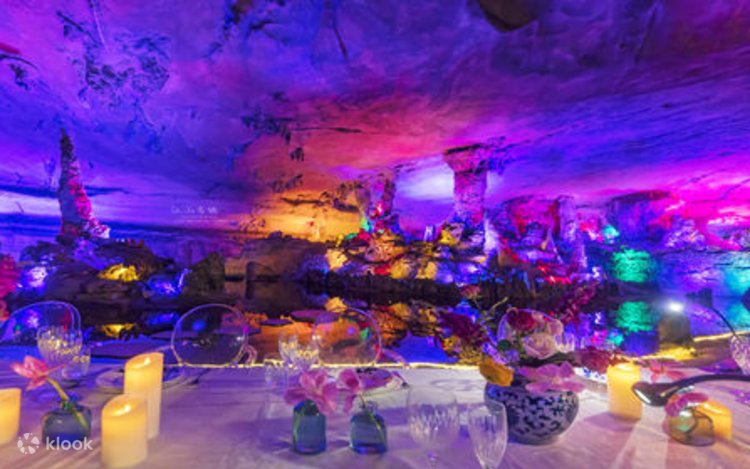
Description: Qixingyan (Seven Star Crags) operating hours: 8:00-18:00, with groups entering the Qixingyan caves for tours every half hour


9
Qixing Scenic Area
Save to wishlist

Open today: 08:00-18:00

Suggested duration2-4 hour(s)

No. 1, Qixing Road, Qixing District, Guilin City
Packages
20 Nov
21 Nov
22 Nov
All
Seven Star Scenic Area Adult Ticket
Admission to: Seven Star Park Adult Ticket
 Valid on the selected date
 Conditional cancellation
 48-hour confirmation
Package details
¥ 1,317
Seven Star Scenic Area Adult Ticket
Refresh to make things right again

48-hour confirmation
See less

Valid on the selected date
The voucher is valid only on the specified date (and time if applicable)
See less

Conditional cancellation
100% refunds will be issued for cancellations made at least 2 day(s) before the selected activity date. Contact Klook customer service for any refunds
0% refunds will be issued for cancellations made at least 1 day(s) before the selected activity date. Contact Klook customer service for any refunds
See less
About this package
What's included

See less
Not included


See less
Things to note
Amendment Policy
- Unused can be unsubscribed at any time.
- Partial refunds are not supported for this order.
- To reschedule, please cancel your current booking and rebook.
Eligibility
- Ages 18 (excluding) to 60 (excluding) (age calculated by birth date, based on the date of travel);
- 120cm (inclusive) and above;
Booking limitations
- Reservation required 1 hour in advance; can be used 1 hour after successful booking.
How to use
Usage validity
- The voucher is valid only on the specified date (and time if applicable)
How to redeem
- Present your mobile voucher
Address
- Seven Star Scenic Area
- No. 1, Qixing Road, Qixing District, Guilin City
Reviews
Kean *********
2024/08/28
Great 4.0
no much visitors. Price can be cheaper then only worth to visit. Will not visit again if price still this high. kinda ordinary park of without that camel mountain.
Guide
- As an epitome of Guilin's landscape culture, Qixing Mountain showcases the characteristics of Guilin's green mountains, clear waters, unique caves, and beautiful rocks.
- Huabridge is one of the Eight Scenic Spots of Guilin, located in the Qixing Scenic Area on the east bank of the Lijiang River, offering beautiful scenery to visitors.
- Qixingyan, a natural karst cave, is famous for its unique geological features and was called the "First Grotto-Heaven" by the great traveler Xu Xiake.
Located on the east bank of the Lijiang River, Guilin Qixing Scenic Area is renowned for its “green mountains, clear waters, unique caves, and beautiful rocks.” As an epitome of Guilin’s landscape and a landmark of Guilin city, Qixing Scenic Area holds two positions among Guilin’s ancient and continuous Eight Scenic Spots: Qixingyan, known as “Qixia Zhenjing” (True Realm of Rosy Clouds), and Camel Mountain, known as “Hushan Chixia” (Red Clouds of Pot Mountain). The great traveler Xu Xiake explored Qixingyan twice, earning it the reputation of “First Grotto-Heaven,” while Camel Mountain, with its unique karst landform, has become a symbol of Guilin’s landscape—Guilin’s second city emblem. However, what literati and poets love most is the reflection of Huabridge, where they can paddle on the Xiao Dongjiang River, gaze at the stone bridge from afar, and listen to Huabridge narrate the vicissitudes of history.
You might also like...
Explore more on Klook
Popular Hotels and Places to Stay
Nearby Transport Options
- 1 China trains
- 2 Shenzhen to Guangzhou train
- 3 Shenzhen to Shanghai train
- 4 Shanghai to Hangzhou train
- 5 Beijing to Xian train
- 6 Chengdu to Chongqing train
- 7 Shanghai to Suzhou,Jiangsu train
- 8 Suzhou,Jiangsu to Shanghai train
- 9 Shanghai to Nanjing train
- 10 Beijing to Shanghai train
- 11 Shanghai to Beijing train
- 12 Guangzhou to Shanghai train
- 13 Shanghai to Guangzhou train
- 14 Guangzhou to Shenzhen train
- 15 Guangzhou to Foshan train
- 16 Chongqing to Zhangjiajie train
- 17 Hangzhou to Shanghai train
- 18 Shanghai to Chengdu train
- 19 Chongqing to Chengdu train
- 20 Kunming to Lijiang train
¥ 1,317
All you need to know
Attraction info

Opening hours
See more
All year
Mon ~ Sun
08:00 - 18:00

Location
No. 1, Qixing Road, Qixing District, Guilin City

Guidebook
- As an epitome of Guilin's landscape culture, Qixing Mountain showcases the characteristics of Guilin's green mountains, clear waters, unique caves, and beautiful rocks.
- Huabridge is one of the Eight Scenic Spots of Guilin, located in the Qixing Scenic Area on the east bank of the Lijiang River, offering beautiful scenery to visitors.
- Qixingyan, a natural karst cave, is famous for its unique geological features and was called the "First Grotto-Heaven" by the great traveler Xu Xiake.
Located on the east bank of the Lijiang River, Guilin Qixing Scenic Area is renowned for its “green mountains, clear waters, unique caves, and beautiful rocks.” As an epitome of Guilin’s landscape and a landmark of Guilin city, Qixing Scenic Area holds two positions among Guilin’s ancient and continuous Eight Scenic Spots: Qixingyan, known as “Qixia Zhenjing” (True Realm of Rosy Clouds), and Camel Mountain, known as “Hushan Chixia” (Red Clouds of Pot Mountain). The great traveler Xu Xiake explored Qixingyan twice, earning it the reputation of “First Grotto-Heaven,” while Camel Mountain, with its unique karst landform, has become a symbol of Guilin’s landscape—Guilin’s second city emblem. However, what literati and poets love most is the reflection of Huabridge, where they can paddle on the Xiao Dongjiang River, gaze at the stone bridge from afar, and listen to Huabridge narrate the vicissitudes of history.